Showing posts with label weave structure. Show all posts

Friday, September 14, 2012

The Woven Pixel Goes to Handweaving.net

Front Cover of The Woven Pixel

The Woven Pixel: Designing for Jacquard and Dobby Looms Using Photoshop®, Alice Schlein and Bhakti Ziek, was first published in 2006 in physical form. It was a 362-page black & white book with accompanying compact disk; the CD included all of the major illustrations in color, and all of the more than 1400 weaves described in the book immediately loadable as Photoshop Pattern Presets. The book went through two print editions.

After all the physical copies were sold in 2010, the authors offered the book and CD contents as a digital download, at a reduced price. Sales of the digital download continued until the present time (2012).

In the original TWP, the authors were working with Photoshop CS2 and Elements 4. The Adobe software has gone through many versions since then, and as I write this, Photoshop CS6 and Elements 10 are being sold. The techniques described in the book remain mostly valid for these later versions, although the user may have to look for  different paths to achieve the same ends.

The original TWP contains lists of resources, some of which are sadly out of date.

The vast majority of the book, however, remains as valuable today as it was in 2006: chapters on jacquard history, jacquard design, weave structures used by jacquard and dobby weavers, and an extensive bibliography are among the many gems to be found here.

The authors are not inclined to undertake a major revision of TWP, but want to ensure that this important text remains available to the weaving community. Toward that end, we have made an arrangement with Kris Bruland at www.handweaving.net to offer the digital version of the book, minus the CD, as a free download. We are grateful to our many supporters who have invested in the print and digital versions of the book and CD; without them we couldn't have committed two years of our lives to the work. The original CD will not be included in the free version of the book, but will be available as a digital download at a cost of $100. Contact Bhakti Ziek (ziekgoodwin[at]gmail[dot]com) or Alice Schlein (aschlein[at]att[dot]net) for more information.

We hope you will agree that TWP was an important contribuion to the world of jacquard design and that  it will continue to inspire weavers and add to the spirit of sharing which  is a hallmark of the present-day weaving community.

Back cover of The Woven Pixel

Friday, November 26, 2010

Sky Weavings

Detail of "West" by Bhakti Ziek

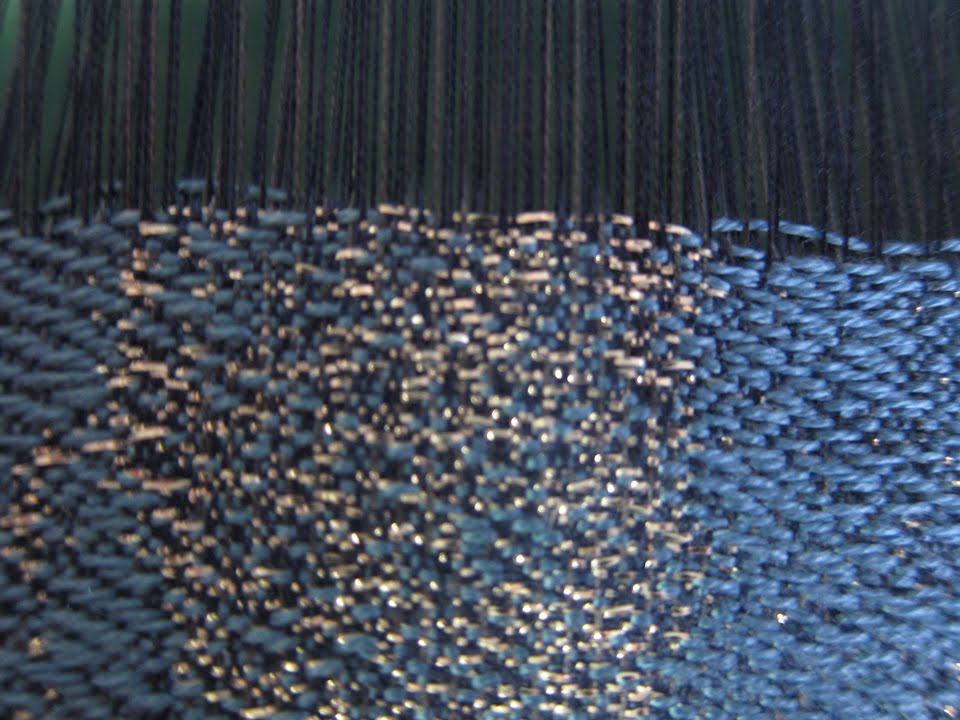
I am weaving a pair of sky weavings: "East" and "West". Two wefts alternate, a blue tencel and a silver gimp, in structures that bring one to the front and the other to the back ((weft-backed structures). When you combine structures in one weaving, you have to be sure that one is not significantly tighter than the other, or you will have take-up problems. In theory my five structures were compatible, but in fact they weren't. I created an image file that was pixelated, and the switching between structures happened so often in some areas that the wefts could not pack down evenly. You can see what happens in the two images below: the fell line of the cloth becomes uneven and the reed cannot hit the cloth evenly.

Fell of the cloth is uneven

Reed hits one edge before the other

Thinking of what I could do to solve the problem before it became so exaggerated that I would not be able to complete the weaving, I came up with the idea of hand-picking the weft in the tight areas. I often say that I love the TC-1 loom because it allows me to use all the knowledge I have acquired over the years as a weaver. This was one of those times that I used a process that I thought I would never have to do again on a jacquard loom. The pictures below show what I did. The first image shows the blue weft going across the cloth in the normal shed. As you can see, the cloth curves up where the weave structures are tighter than the other structures.

Weft following normal shed

Not on every pick, but often, I would take the shuttle and bring the weft to the back of the cloth in the tight areas.

Blue weft going to the back in center area

This enabled the next pick of silver to pack down tighter, making the fell of the cloth more even. It seemed to work fine, and 6420 picks later, the first weaving, "West" is woven. No turkey for us on Thanksgiving, but plenty of gratitude at the loom.

Silver weft packs into space more evenly now.

Sunday, November 14, 2010

Draw Like a Weaver

5 Wefts Used to Create This Weaving

Do you want to know how to draw like a weaver? I'll use a recent weaving built with five wefts as an example. Take 6 crayons or pencils or inks and arrange them so you will use them in the same sequence, over and over and over. In this case, weft one (color 1) is salmon, weft/color 2 is black, weft/color 3 is dark green, weft/color 4 is white, and weft/color 5 is light green. The sixth color represents the warp--red in this case. It might help if you have a page with horizontal lines on it, or under it as a guide, or just go freehand--weavings tend to be wobbly even though they follow a grid.

How a Weaving Builds

Now make a series of horizontal dashes, on the same line, with the red color that represents where you want that color in your image. Follow this with some dashes on the same line with the black color where black should go. Put the black down and pick up the light green and draw your light green dashes on the same line. Then put that color down and pick up the white color--and draw your horizontal dashes on the same line, followed by some horizontal dashes of the dark green. Depending on your image, you might have filled in the complete horizontal row, if not, fill in the spaces with the red color, which represents the warp. Now move to the next line and continue building color by color, line by line. Some lines might not show any of one color. You get a break here drawing on paper, but as a weaver, that weft is still thrown, working at the back of the cloth rather than the front.

Most of my recent weavings are composed of series of four or five weft colors. I am averaging 140 picks per inch--sometimes more, sometimes less. If using four wefts, that means they pack down to look like 35 horizontal rows composed of four colors, plus warp color. To be fair, I don't actually draw my images line by line but use Photoshop to make compositions and insert weave structure. The book Alice Schlein and I wrote, The Woven Pixel: Designing for Jacquard and Dobby Looms Using Photoshop®, is a great resource if you want to learn how to do this. When I want to weave a design though, I do have to build it, pick by pick, and in this example that would mean five picks (wefts) create one horizontal row in the cloth. It is not unusual for my weavings to exceed 5000 picks. I am standing at the loom most of the time, though recently I obtained a stool that I can use too. 300-400 picks per hour adds up to alot of hours at the loom. What would be excruciating for some people turns out to be sanity for me.


Sea Glass formation on Bear Island

Sea Glass by Bhakti Ziek, handwoven jacquard 2010

Night Cap

Sometimes though I want things to move a bit faster. Sea Glass was woven in a new structure for me, a lampas that used a plain weave ground against a three shaft patterning twill. I dropped my wefts to three systems in the center, but created 15 structures with them. The sides of the weaving are a damask structure using just one weft. When I saw this bottle of wine at the store I had to buy it. I didn't know sea glass existed until the summer vacation in Maine, but the wine and wikipedia showed me it is a well-known phenomena.

Sunday, March 7, 2010

Goodbye Loom

Last project on dobby loom

Yesterday we said goodbye to the beautiful dobby loom that took center stage in our front room. The first step in disassembling the loom was to cut off the yardage that was on the loom. I laid out the damask block section on the table and am relieved to see that it is long enough to go edge to edge. I hope after washing it will still cover. Now the front room is empty, encouraging us to bring the sofa from the second floor office downstairs to be more useful.

Thank you to everyone who sent me comments on my last blog post, many of them came in direct emails to me. They all were thoughtful and encouraging. I have been rereading Jack Kornfield's wonderful book, A Path with Heart, and, honestly, I want to underline every sentence. It is reminding me that each of us has to forge our own way, authentic to ourselves. As soon as I wrote the last post, I knew that I had already come to some decisions--like focusing on weaving work for an exhibition, and not letting other things interfere with that commitment. I will have to finalize the first work soon, since the Vermont Weavers Guild is coming to see my studio on Saturday.

If you are on Weavetech (a yahoo group) or the Complex Weavers Jacquard Study Group, you already know that Garth Fletcher, the developer of JacqCAD Master, a software specifically for jacquard design, has announced that the program is now available as shareware. He explains it all on the website. When I taught in universities, this was one of the programs I used, and I had created and saved hundreds, maybe thousands, of weave structures in that program. When I left academia I no longer had access to any of that information--and it is one of the reasons I was interested in developing Photoshop for jacquard (see The Woven Pixel for those results). With my impeccable sense of timing, about a month ago I cleaned up the two computers that had all my JacqCAD files on them and threw those files into the trash! Oh well. I probably won't go back to that program, since I am quite satisfied with my method of designing and weaving using Photoshop, but it is an excellent program and Garth has offered a gift to everyone in the field.

I want to mention the Osloom project again. I like the spirit of this project. It is an attempt to open up new technologies in weaving to a larger group of people. I also want to say that I suspect that as that project unfolds, they are going to discover that the high cost of the current hand jacquards is due to the expense of manufacturing parts that are specified to the tiniest fractions of variation--and anything less than that will cause problems with the loom. Vibeke Vestby began her investigations that led to the TC1 with the same spirit of innovation and sharing that Margarita Benitez has for the Osloom. The expense of the loom has not increased because of greed but because of the value of the dollar versus the Norwegian krone. Despite the headaches of manufacturing, Vestby and her company have continued to improve the loom, and continue to offer the best customer support possible. As I return to my TC1 this week, I know for certain that I will be sending silent blessings off to Vestby, in gratitude for all she has done for me and other weavers. In that spirit, I wish Benitez support for her project, and hope you will donate to her kickstarter project. If enough of us donate $25, it can add up to the sum she needs.


Monday, February 8, 2010

Modifying Plans

I had this plan to weave a tablecloth with an excerpt from an online I Ching advice site that i got last week. It said:
"You have passed this way before but you are not regressing. This is progress, for the cycle now repeats itself, and this time you are aware that it truly is a cycle."

So I spent time doing it in various methods, including the diagonal word method described in Alice Schlein's new book, and finally decided on my own handwriting in a vertical column, with some circles at the bottom to represent cycles. My total pegplan was 2160 picks. I was assuming 20 ppi when I made the design, with 24 epi in the warp, so I designed it at a pixel aspect ratio of .833. Everything was going along fine--I finalized my image, saved it to my USB jump drive, and turned on my old macintosh, which has a driver for my AVL dobby loom. Then I realized that the computer was from an era before USB and I couldn't transfer the design that way. So I made a CD and saved the image as a pict file, since my old software uses that format, and discovered the old computer can not read the new disks. Uuuugghhhh....urrrrr....hmmmmmm.

I opened up the software and clicked in a simple 8-shaft satin/sateen block design and saved it. Probably it is a better image for a tablecloth anyway. Then I decided, why waste the electricity on such a simple design--so I hand pegged a chain of 24 dobby bars, and put it on the loom. Tomorrow I am going to put some floating selvedges on the loom and get started weaving. This is going to be my last weaving on the AVL, since the loom has found a new owner and will be moving to Maine. I have offered the old computer with the loom, but after my experience tonight, I have also suggested she rethink that offer and go with a new model and current software.

I am not giving up on that saying though--it is too good--and will weave it on my TC-1 as soon as I get back to that loom, which will be soon.

Table by John Parker

Detail of table showing some math

This weekend we went to the annual sale at the East Barre Antique Mall and saw some wonderful things in the booth that John Parker has, including the table shown above. The math on the table has a date from 1929 (or something like that) and it really reminded Mark and me of a weaving I did where I scanned the page of mathematical calculations for a jacquard as the background of that jacquard, and then imposed sketches I drew in Italian museums on top of the math. It was called Lucca Math. It was made and sold in the era of slides, so I don't have a digital image that I can post here. You will just have to take my word that this table and my weaving are first cousins.

Last summer temporary entrance to SAIC

I am posting an image of the temporary entrance to the School of the Art Institute of Chicago that I took last summer, as a way to announce that I am going to be teaching a three week intensive summer course there again this summer--June 1 to June 18, 2010. You can see a slideshow of the work produced last summer by clicking on the notice in the sidebar to the right of this post. When registration begins, full-time students at SAIC get to sign up first, but usually there is room for other students. Last summer about one-quarter of the students were non-traditional or attending other programs. It was a fantastic mix of people, all levels of experience, and I look forward to the upcoming class.

Sunday, October 25, 2009

Friends from The Netherlands

Mark, Anne Mieke Kooper and Hugo Poelstra at BigTown Gallery

We have had a wonderful week with our friends, Anne Mieke Kooper and Hugo Poelstra, from Amsterdam. Anne Mieke and Hugo have visited us in every place we have lived since 1984 except two places. We met when Anne Mieke and I were both working for Jack Lenor Larsen in NYC in 1984. It was fun sitting around last night comparing our Philadelphia artists' loft spaces, our Brooklyn apartments, the NM straw bale, and our present Victorian beauty. Each had their own good points and we concluded that we are happy to have experienced them all. We share a love of art, and went to see the current Wood Show at BigTown Gallery in Rochester. It is a good exhibition, and looking at the space, they felt it is going to be a good venue for our work. Hugo was a city planner for Amsterdam, at one point in charge of bicycle traffic planning, so of course we went next door to Green Mountain Bikes. The owner, Doon, was so helpful and informative (when was the last time I owned a bicycle? I think 1979 in Lawrence, KS). We will probably get one for Mark in the near future, then one for me, after I try his and if I like it.

I just added a few more images to my Picasa web album of available weavings. I have a closet upstairs where everything is stored, and while I was in Indiana, Mark taped, spackled, and painted it so it is now the perfect storage space for important items. I plan to take digital images of all the weavings so I have a complete record of what is available. It seems easier than trying to get digital images made from slides. Below is one of the weavings I just added, Lampasso for Fra Angelico. There isn't that much written about lampas (we have a good chapter in The Woven Pixel), but John Becker wrote about it in Pattern and Loom. That book, published in 1986, almost went out of print as quickly as it came on the market, and currently used copies sell for exorbitant prices. I was one of the lucky people who bought a copy in 1987. Today Wendy Weiss sent me a link to a site where Donald Wagner has posted the book so people can have it as a free download. Click here to get it. It should be in every weaver's library (as should be The Woven Pixel).

Lampasso for Fra Angelico by Bhakti Ziek

While I am pointing out other web sites, I thought I would send you to the MAIWA post about the unfortunate decision by the Canadian government to deny Ashoke Chatterjee permission to come to a MAIWA symposium. In response, MAIWA organized a video conference, which shows both their commitment to artisans associated with their organization, as well as their ingenuity. A few years ago I had the pleasure of speaking at one of their symposiums, and I left with admiration for everyone involved with MAIWA, as well as envy for the population that lives near them in Vancouver and can attend their fabulous events.

It's so nice to go down to breakfast and see Anne Mieke and Hugo at our table drinking tea (coffee comes later), but I almost missed them the other day because my new alarm clock, the roofers, didn't go off. They are almost done, as you can see below, but had to go somewhere else that morning. We had a fierce rain yesterday, sort of a proofing of the roof--everything dry inside.

Two views of house with its new metal roof

Mark putting up new shingles on dormers

Wednesday, July 29, 2009

Testing Lampas

Lampas tests on TC-1 loom

I wove these tests of lampas on Sunday. I used the lampas structures from The Woven Pixel that are designed for a warp ratio of 3 ground ends to 1 pattern end, and a rotation of three wefts (1 ground weft and 2 pattern wefts). I was trying to see if it made a difference if I designed full width (880 ends), for just the ground warp (660 ends), or for the units of 3 ground warps to 1 pattern warp (220 ends). After putting in the structures, I expanded each test by three in the height (the number of picks) because I used three wefts. I didn't really notice much difference except the obvious one that designing on only 220 ends made my writing cruder. I did use different size yarns in the tests, so the picks per inch differed in each example. I think if I started with a digital image and then reduced it, I might have seen more variation than here, where I drew my designs.

Detail of lampas showing longer floats of my pattern warps in the ground structure

I always weave lampas with the pattern warp end that will tack the pattern ends raised over the ground weft. It means my ground structure (a 4/1 satin) is modified by these floats, which show up as a twill line (since they weave a 1/2 twill). Depending on the angle of viewing, and how the light hits the cloth, this disruption of the satin hardly shows, or clearly shows. I could weave two layers in that area, keeping the pattern warp and wefts to the back, but I like it this way.

Tomorrow I am going to test a design using 4 wefts. This always happens, I do these tests, then when I start some "real" work, the tests are irrelevant. I am going to start at 120 picks per inch and then modify my image depending on what I find. I have been playing with modifying colors in my image in Index Mode/Color Table, to get a sense of the colors I plan to use--but I won't really decide until I see them woven. I do like the quality of this warp very much and am glad I decided to postpone putting on another black and white tencel warp (though I have a 10 yard warp wound and ready to go).

Sunday, June 7, 2009

Birthday Cake

It's always a good morning when I return to bed with my cup of coffee and read. It's a sign of relaxation and leisure. This morning I noticed that the leaves on the trees almost obliterate the neighboring houses and I am left with a view of the hill behind town that reminds me of the view from the bedroom of our former home in New Mexico. I always felt that hill was a protection, and watching the morning sun hit it and turn it golden was always a thrill. Selling that place, with a house that we built ourselves with great effort and hope, was emotionally difficult, and I think I managed it by denying my attachment. So it seems that as I settle joyfully into Vermont, I can relax my internal walls, and allow memories of New Mexico to return. I remember when I studied psychology in the '60's how taken I was by the theory of cognitive dissonance. Upon making a decision, one is at first overcome by the sense that you made the wrong choice, and then that quickly is replaced by a firmer conviction that you indeed made the right choice. So now I feel safe enough to allow good memories of New Mexico to return without it threatening our decision to move to Vermont.

I wanted to post pictures of my weft-backed double weave for days, but I didn't want my friend Sara Tucker to see, because I wove her a birthday cake. Yesterday, after the opening of Into the Woods, we had a joint gemini party. You can see her and her sister Martha holding the weaving below, as well as strawberry shortcake. 

Sara Tucker (r) and her sister Martha holding Sara's birthday cake weaving

I actually gave Sara the weaving earlier in the day, and she put it on the back of a chair as a display for everyone to see at the party. It amazed me how it fit perfectly, and suddenly I really could conceive of a furniture collaboration with Mark--something he has been interested in for a long time. I don't know how long it will take for that to take shape, but probably now that I can visualize it, it has a chance to happen.

Sara's Birthday Cake weaving on display for party

I also wove a birthday cake for my Aunt Bess' party, which will take place August 30th. She is going to be 100! I don't think Bess is reading this blog, so she probably won't see the weaving until her party, but if she is, then she can look forward to seeing it in person. I am posting both the front and back of her weaving, so you can see how different they are. I wove both birthday cakes face down, so I saw the colorful floats develop, not the sharp definition of the front. Both these weavings made me very happy. Pleased by the complicated structure that made the imagery possible, pleased by the thought that I was giving them to specific people who make my life better, and pleased by the silliness of them, which seemed perfect as a birthday present. At the party, my other friends lined up to tell me when their birthdays are coming, so they too can get these cakes. 

Front of Aunt Bess' Birthday Cake weaving

Back of Aunt Bess' Birthday Cake weaving

And besides having a pot luck with good friends and the most delicious food, much of which came from recipes in Deborah Madison's book, I received a wonderful old collapsible wooden ruler from the Sacca/Billings and an intriguing collage from Laurie Sverdlove, who co-curated Into the Woods with Dian Parker. They are pictured with Tom Batey (who did the card) below. I took this picture before the opening, which is good, because the gallery was packed for the next few hours and all my pictures just show backs of people. The show was appreciated by all and the hard work these three people did was justly praised.   

Right to Left: Laurie Sverdlove, Dian Parker, and Tom Batey, standing at side of Laurie's painting just before opening of Into the Woods 

So what was I reading this morning? Flatbreads & Flavors by Jeffrey Alford and Naomi Duguid. I haven't cooked from it yet, but I will. They are travellers and cooks and I relate to their writing. I go through phases where I stop reading and stop cooking, and life is a little duller for the lack of these activities. Getting ready for the opening and party got me in the kitchen, and eating Holly's foccacia with Liz's green cheese spread and Mark's lentil soup made me want to find more delicious recipes. Tonight I am going to try Alford and Duguid's Pizza with Rosemary and Garlic, and add the rest of the onion filling from Madison's book that didn't go into the empanadas. Ahh, good living! And just look at the poppies in our garden. 


Monday, June 1, 2009

June Beginnings

New toys--a mangle and a braid twister

It has been raining here and I keep reminding myself that in New Mexico we would have welcomed days of steady rain, but still I miss the sun. Mark and I drove to New Hampshire at the end of the week in the pouring rain to pick up an old mangle. This and the braid twister came to me via Edith House. She read that I wanted the braid twister on my blog and ordered one for me (maybe I should have a running wish list on the side bar). I was thrilled--especially since I had ordered one on ebay myself--my first and last attempt to use that site--and what I got was the head from a machine. Completely useless without the handle. I did check back and saw the ad definitely had the complete twister--and I could have lodged a complaint and sent it back. But that didn't make sense since the postage to/from the seller was more than the tool itself. Anyway, when Edith gave me this twister I felt like my story had a surprise happy ending. She keeps the list of looms and other tools for sale for the Vermont Weavers Guild and knew about this mangle for sale, so she put me in touch with the seller. I have been using tencel in my recent work almost exclusively, and seeing how Edith and Trudy Otis finished their tencel scarfs with the mangle enticed me to buy this.

Double Weave Comparison - front

Double Weave Comparison - back
I also finished the warp on my TC-1 and was able to cut off the cloth yesterday. I had forgotten I had woven a comparison weaving in double cloth--but there it was at the beginning of the roll. Because I designed the structures for light lifts, the back of the cloth is almost all warp-faced. Quite a contrast to the front. I wanted the back of my last weavings to show weft floats, so I created weft-backed double weave structures. Even saying that makes my head spin. The day I was making those structures I definitely thought I was having a complete mental melt-down. After awhile, it seemed like all structures were the same--and I still feel that sometimes when I look at my wall of studies--they all are about warp or weft floats--the differences are so minute. I wonder if I am being side-tracked by this level of detail. But then I think "weft-backed double cloth" and something comes alive in me. You can see a detail below of the back of one of the pieces I wove. On the front it has areas of warp-faced white and warp-faced black, and then areas of single wefts working with either the white or the black warps (though I don't think the warps are showing much since the weft floats are doing a good job of hiding them). On one of the weavings I did put an area of the back on the front. I will post images as soon as I finish them. I wove them face-down so the lifts would be lighter than if woven face-up. It is always a thrill to take something off the loom that you are hoping is weaving correctly but you can't see (well, I could have used a mirror) and find out it worked.

back of "weft-backed double weave"

I did weave a small sample of the weft-backed double weave that I can run through the mangle and see what happens. That will have to wait until I get back from Chicago in July. Meanwhile, here is the invitation to the exhibit, Into the Woods, curated by Dian Parker and Laurie Sverdlove, which opens at The Chandler Gallery in Randolph on June 6. The two of them have done so much work investigating artists in Vermont whose work would fit with the theme, compiling what will be an exciting show, and organizing everything to high standards. It is very generous of them to do this. Of course I am thrilled that both Mark and I will have work in the exhibit. The opening is from 4-6 p.m. That's my birthday--I think I will just pretend everyone is there to celebrate with me--celebrate the fact that I am alive and well and can think of things like "weft-backed double weave" which really is something to celebrate.

Monday, May 11, 2009

Comparison Charts

The Weaving Lesson: Warp-Backed

I have woven three weavings for my series, The Weaving Lesson, that are comparisons of the same starting image. Above is the warp-backed version, and below is the lampas comparison and a detail of it.

The Weaving Lesson: Lampas

detail of The Weaving Lesson: Lampas

The third one, a double cloth using 12-shaft satin structures, is finished, but still on the loom. I can only show a detail for now. I used two wefts, but changed their colors to delineate sections--the main weaving, an addendum, and then a second addendum.

detail of The Weaving Lesson: Double Weave

I can see the end of this warp. It was ten yards, which is long for me, but it wove quickly because I was interested in the work (plus I had some help from my two tutorial students). Thinking about involvement, engagement, and interest, I have decided that time is too valuable to squander on things that don't interest me. I could say it is aging that makes me this way, but actually I have always been following this philosophy. It didn't make sense to me in my 20's to spend my prime energy on a sensible career so I could be comfortable in my old age--travelling was much more enticing and in the end those years in Guatemala were crucial to my development as a weaver.

Now that I am old, it still seems crazy to spend my energy on something that seems like drudgery. I like to work, but I guess I made demands on that work--that it interest me. I also put a ten yard warp on one of my macombers last week, intending to do more place mats. The Vermont Open Studios is quickly approaching and I plan to have some place settings on my table that show the collaboration between Holly Walker, Elizabeth Billings and myself. However, I think now that my contribution will have to be selected from what I have already woven. And the ten yards on the macomber loom can be used by visitors to sit at a loom and experience what weaving is like.

Here is the totally inspiring view from the window at the top of the steps as you enter my studio.

View from my studio window

Friday, May 8, 2009

Working with Tommye Scanlin

A radiant Tommye Scanlin weaving at the TC-1

I am so glad I decided to offer tutorial weaving lessons in my home. In the last two weeks I have met two of the nicest women in the world, and even better, I have gotten to work with them. Working side by side with someone is the best way to become friends. Sharing a passion for weaving, as I did with both Betty Vera last week, and Tommye Scanlin this week, means these friendships will go on for a long long time. Tommye had never woven on a TC-1 before, but she took to it like a fish in water. You can see how radiant she looks weaving on the loom--and she looked like this for three solid days! She is home now (she called from Georgia to say she arrived) and probably, like me, dragging her feet, since we were up at 4 a.m. to get to the airport for her early flight. I am also sure, like me, that she is euphoric from the burst of learning that occurred for both of us in the last three days. 

Tommye's four weft taquete in process

The first day, to familiarize Tommye with the process of going from design in Photoshop to cloth at the loom, we took one of her drawings and worked it as both a two-structure damask and a shaded satin with multiple structures that shaded in the weft direction. Since Tommye is a tapestry weaver, working with a loom controlled weft-faced structure made sense, so the second day we began exploring taquete. She wove many two inch sections of a leaf design, using different variations of the taquete structure but at the end of the night none was quite right. In the morning, fresh from sleep and aided by good strong coffee, we tried something different--resizing the image down in size to the "face" dimensions. Of course this was suggested in the taquete and samitum chapter of The Woven Pixel, but maybe as co-author I thought I could ignore it. When weaves were inserted, and the image expanded for weaving, the wefts could pack down and cover the inner warps. After several more two inch sample sections were woven, Tommye made her choices of file, type of yarn, and color, the image was resized for the correct picks per inch, and she wove a lovely piece, which you can see above, in progress.   

Tommye cutting off her weaving

When Tommye cut off her weavings, they measured 108.25 inches. This is really amazing considering that we spent hours sitting downstairs at the computers going over ways to modify images in Photoshop as well as creating weave structures. She told me she hadn't expected to weave much, perhaps a few inches of samples, just to understand.

Dylan loving Tommye's weaving

As soon as we cut off the fabric and put it on the floor to look, Dylan (also known as Biggie), who always knows where the action is and who likes to be in the center of the best energy, took possession of Tommye's cloth. 

Tommye holding up her finished cloth, which measured 108.25 inches (not all of it is showing in this photograph)

So another very satisfying experience teaching and learning from another master weaver has come to an end. Really, I should say, has started. I imagine Tommye will write about these days from her perspective on her blog, and I hope she will post good images of the weavings, since I couldn't capture them in the evening light. We had several discussions about the possibilities of having a dialogue between the contemporary tapestry weavers, active in ATA (American Tapestry Alliance), and jacquard weavers active in Complex Weavers. This experience working on the TC-1 gave Tommye a much better insight into the creative possibilities of handweaving with today's jacquard technology. Sometimes it seems as the fiber field has splintered into many focus groups, and forgotten to talk together about common ground. Maybe in Albuquerque in 2010 there will be an opportunity to get these two groups together for a dialogue. If not, it has already begun with the two of us, and has generated an exciting collaboration that we will pursue, but I will leave that to discuss when it has actually happened.