Showing posts with label TC-1. Show all posts

Wednesday, July 1, 2015

July Already!

Bhakti Ziek preparing her Mirrix Loom
It's July already and I never got to post in June. So much for my intentions to be a regular blogger. But here I am today, preparing my Mirrix loom so I can take it to Penland with me. I leave on Sunday and have a full class of beginning weavers. Some people have expressed "sympathy" to me about teaching beginners but it is my choice. I could have proposed anything for my workshop but I want to work with new weavers. I hope to entice them to begin a journey that goes on for years.

Two tencel scarves woven by Bhakti Ziek in June 2015
I plan to start my students with 8/2 tencel and weave scarves (or table runners or just plain cloth). If someone wants to work with other yarn, that is fine--I see my role as explaining and demystifying the process of weaving on a floor loom. I wove the scarves above because I didn't know whether I prefered 24 epi or 30 epi for this yarn. Guess what--after washing and ironing I still don't know. At least the students will have physical examples to touch to help them make their choices.

Detail on top shows the two sides of scarf woven as a 1/3 twill (so reverse is a 3/1 twill)--there are changes of structure woven in stripes but always 1/3 tie-up; bottom shows the other scarf, woven as a 2/2 twill, with the weft color sequence forming a plaid (both sides of this scarf are the same); scarves woven by Bhakti Ziek, June 2015
Alpaca and silk scarf woven as a deflected double weave, by Bhakti Ziek
Here is an image of the second deflected double weave scarf I made using alpaca from Wild Hair Alpacas and silk from Henry's Attic. I was really pleased with the results and look forward to more exploration of this structure with those yarns. I sent this scarf and the other alpaca scarves out to Colorado to the store at Wild Hair Alpacas. They are having several open houses this summer and fall, so check their website for more information.

Third tapestry sampler woven by Bhakti Ziek for the online course taught by Rebecca Mezoff
I am continuing with Rebecca Mezoff's tapestry class online. This is my third sampler, which concludes the end of part two. There is another part to go--which makes me happy. I still have to finish the three studies--sew in the ends, that kind of thing. The instructions are in part three, along with learning to work with cartoons and weave shapes. I am going to do another study though of what we covered in parts one and two before proceeding with the rest. That's what I am doing in the first image--preparing the warp for another study that will probably be blocks and stripes, hatching and interlocks, demi-duites and floating bars. Rebecca has a video showing work by many artists using these processes and I am in awe of their skillfulness and creativity. Most of them are quite intricate narratives, which of course is a great tapestry tradition, but I am feeling very minimal these days and I think squares and color are going to be enough for me for now.

Demi-duites in top form are very neat on the face of the tapestry, but a mess on the back; detail of tapestry weaving by Bhakti Ziek, woven as a study in the online course taught by Rebecca Mezoff
Mark Goodwin preparing walls of Chandler Gallery, to hang Sisyphus, a seven panel weaving by Bhakti Ziek
There is another opportunity to see my seven panel weaving Sisyphus! The current show at Chandler Gallery in Randolph, curated by Rebbie Carleton, is called Creative Cosmos. It is up through September 7th. There will be a reception for the artists on August 8 from 6-8:30 pm and earlier that day, at 4:30 pm, the artists will talk about their work. My wonderful husband, Mark Goodwin, once again helped me hang my work. Okay--he did all the work and I watched.

Three panels from the seven panel weaving, Sisyphus, by Bhakti Ziek, 2015. Each panel is 28"w x 88.5"h, silk, cotton, metallic yarns, handwoven satin damask, hand woven on TC1 looms
Mark Goodwin's studio, June 2015
I will get home from Penland the night before Mark has an opening of new work at BigTown Gallery on July 18th. Perfect timing. His work and paintings by James McGarrell will be up from July 15-September 6, 2015. Meanwhile if you haven't seen the Viva Cuba! exhibit that is showing there now, it is not to be missed. 

Friday, May 1, 2015

Studying Tapestry Weaving

Bread and Puppet 2015 Calendar
I know I said I would do a new post in a week, and that was three weeks ago, but really, three weeks is much better than a year--and I do say I am an "erratic blogger" right up there under my name. So here is my tale of how I came to my current study of tapestry weaving--a meandering story of course.


Taqueté study by Bhakti Ziek, 2015
Taqueté is a weft-faced structure using two warp systems and multiple wefts, and it is one of the structures I taught last summer at Belinda Rose's studio in Scotland using her Thread Controller loom. The basic structure of taqueté is always plain weave, like tapestry, but the wefts travel from edge to edge, unlike the discontinuous wefts of a tapestry. The wefts should completely cover the warp, and you can see in my study above, that my warp is definitely showing--especially at the bottom. So I began to think I could learn something from tapestry and tapestry weavers and contacted a few friends who are experts in tapestry.


Emergence II by Rebecca Mezoff, 40"h x 40"w, hand-dyed wool tapestry, in the permanent collection of Craig College, Craig, Colorado
It seemed like everyone kept pointing me to Rebecca Mezoff and her online tapestry courses. I wasn't really thinking to take a class, and as a former teacher of weaving (well, I still do teach sometimes but not full-time) I have taught tapestry--but Rebecca has posted some wonderful free videos on the internet and I began to watch everything that was available and realized I could learn alot from her. So I signed up for her Three-in-One Course. You can read all about her different courses and options HERE.


Front (left) and back (right) of Bhakti Ziek's Part 1 sampler from Rebecca Mezoff's online tapestry course.
What works for me, besides the fact that she has made professional videos that are in focus, clear to follow, and funny (so you enjoy watching the videos), is that these are self-directed courses. There is no meet-up time when all the students and Rebecca are online together--you work at your own speed, whenever you want, and you can ask as many questions as you want. Rebecca tries to answer everyone within 24 hours, but my experience is that she responds much quicker than that. I can watch her videos over and over--and I do. In fact, I watch so often that Mark and I think we have a roommate. You also can see what the other students have done in any section--after you post what you have done. That is a really nice feature because you get a sense of sharing without feeling competitive.

Tommye Scanlin's mirrix loom, on loan to Bhakti Ziek
Okay, here is the truth--I wanted a new loom. I saw people using the Mirrix loom in one of the workshops when I taught at the ANWG Conference in Bellingham, WA in 2013. I loved what everyone was doing, and I loved the looms. So for two years I have been wanting one of those looms, and I got it in my head that if I got one, I could work downstairs at the kitchen table by the woodstove at night, instead of going to bed and reading. And Rebecca demonstrates most of the steps so far on a mirrix loom--and that tap tap sound of her beating the weft into place is very enticing. You can hear that tap tap sound at about minute 2:30 of her splicing video.

Macomber loom set up for tapestry in Bhakti Ziek's studio
But I have this perfectly wonderful 24" 8-shaft Macomber loom in my studio and I haven't used it for a long time, and I knew it was a great loom for tapestry--so I couldn't legitimize buying a loom, especially if I didn't know if I was going to be serious about tapestry or not. So I started Rebecca's class and put seine twine cotton (I didn't know about this wonderful yarn before watching her videos) on my macomber.

Start of Part I of Rebecca Mezoff's Online Tapestry Course being woven by Bhakti Ziek
What I was totally unprepared for was my reaction to doing tapestry. I was completely mesmerized and engaged and loved it. My friend Sandra Brownlee explained it perfectly: she said "my fingers were thirsty." (You can experience Sandra's wisdom in The Tactile Notebook workshop she is teaching at Longridge Farm this summer.) I am going to write more about this in a future blog because I think it is an interesting topic, about the differences I perceive between the jacquard work I have been doing and the hand manipulation of tapestry--but it is a big topic and I think I should leave it for a future discussion. Let's just leave it that my hands, which have done so much brocade in the past, and yes, I have done tapestry before, felt at home with the butterflies and moving of weft threads that is part of tapestry.

Tapestry rug woven by Bhakti Ziek about 45 years ago with holes carefully chewed by her beloved dog when she was a puppy--and now is gone but the holes remain
Of course, the same week that I set up the macomber for tapestry, my brother and sister-in-law who own Wild Hair Alpacas in Colorado Springs called to see if I could weave some alpaca scarves for them (that too will be another post). Suddenly my macomber loom was in high demand. And that is when my friend, Tommye Scanlin offered to lend me her Mirrix loom--so I could test the loom in person to see if I wanted one and also free up my macomber for the scarves. The mirrix is pictured above, and yes, I do want one.

Front (top) and back (bottom) of Part II sampler from Rebecca Mezoff's Online Tapestry Course as woven by Bhakti Ziek
I had to finish the warp on the macomber before I could start the scarves, and you can see my work from Part II of Rebecca's course. We are weaving from the back and in Part III I will learn how to deal with all those tails hanging down, and then the back will be almost as clean as the front, and I will be sure to post it for you to see. 

Area of different ways to join wefts in a tapestry, part of the lessons in Part II of Rebecca Mezoff's Online Tapestry Course, as woven by Bhakti Ziek
I am constantly amazed at how the smallest detail can change the effect of the weaving. I pulled out my Peter Collingwood The Techniques of Rug Weaving (the weaving books are all coming off the shelves these days and piling up by my bed for night time reading) and just couldn't understand how the difference between one weft going over the other versus the other going over the first could make a difference, but when I tested it at the loom I saw that he was completely right. That is another thing--tapestry is an ancient process and one that has been used by cultures all over the world--so there never is one way to do anything, and what is right for one group is wrong for another. I really like how even-handed Rebecca is about all the variations. She is quick to point out what others do, and often sends us to videos by other artists, and she is very clear about why she does something, and of course she is teaching us her way, but she always leaves it open for the student to decide what works best for them.

Sisyphus, a seven panel weaving by Bhakti Ziek, 2015; each panel is 88.5"h x 28"w, silk, cotton, metallic yarn, handwoven satin damask; woven on TC1 looms
I didn't have enough warp on my loom to finish all the exercises in Part II, so I will either finish them on Tommye's mirrix or--isn't it funny how things happen-- I met some friends at Brattleboro Art Museum last week so they could see my weaving Sisyphus (I will do a blog post soon about this piece), which is up until Sunday, May 3rd in their current exhibition. Of course I went on and on about studying tapestry, and one of my friends who is moving her studio soon offered to give me her tapestry loom, which she isn't using.

Nilus Leclerc Tissart loom now residing at the home of Bhakti Ziek
So yesterday Mark and I drove over to her place and got the loom. Although she had sent me a picture, I was rather surprised in person to see it is really a sturdy big loom. Luckily we had the topper off the truck, and it just fit perfectly. This loom makes me think I had better get serious. I actually don't have any idea of what I want to do in tapestry. Right now I just love the process of learning and understanding. At the moment I have the sense that despite all my years as a weaver, I know nothing, and there is so much to learn that I am never going to get "there." Of course, I also know there is no "there" and that one of my pleasures right now is that I do know something about weaving, and can grasp the nuances of the differences I am being taught--and this was not something I could have understood when I did tapestry in the past.

I have more to say--and obviously I have many more blog posts that I have to do, since I have promised them to you in this post--but I think I will end by saying, I could finish up Part II and do Part III on my Nilus Leclerc Tissart loom OR I could do it on my own mirrix--since I am buying one from another weaver next Monday. This story has a happy ending.

And thank you Rebecca Mezoff for being such a wonderful teacher and artist and a generous soul. Rebecca also blogs--so go here to see more. The color work she is doing for a new class is totally inspiring. 

Wednesday, August 17, 2011

Tutorial on TC1

Karin Muller La Belle from Luzern, Switzerland working on Bhakti Ziek's TC-1 Loom

It's been a long time since I said yes to a private student but Karin Muller La Belle asked to work with me at a time that fit perfectly with my schedule. I knew I would be finishing work for my upcoming show at BigTown Gallery--finishing meaning sewing, not weaving--and my loom would be available for her to use. Karin is the Studio Director/Manager at the Hochschule Luzern and overseas the weaving, knitting and embroidery studios. I have been extremely lucky with the people who have come to study with me--and I couldn't have asked for a more lovely student than Karin. She had some clear parameters for what she needed to learn and she worked diligently to accomplish everything. One of the things she needed to see was how to reconfigure the loom for different setts. When she arrived the loom was set up with two modules by two modules (30 epi). She wove a sample of shaded satins on the remaining warp (you can see front and back in the picture above), and then with the help of my husband Mark, we reconfigured the loom the next morning in about an hour. Now the modules are one behind another. Then together we wound back a new silk warp (60 epi) and threaded together. By evening she had half of the warp through dents, and the next morning she was weaving double cloth. I love this loom. And I think by the end of the week Karin loved it too. She wove 5.5 yards on the silk warp, leaving me about half a yard to go before I reconfigure the loom back to two by two. You can a detail of the beautiful scarf she wove at the end. I have a TC-1 loom, but anyone interested in the loom today will be getting a TC-2, which sounds like it is about ready to launch.

I had a funny experience the other day. I was doing a google search on Henry's Attic 16/2 linen and was surprised to see a link to one of my blog posts--so I checked it out. It was December 25, 2009 and I had posted an image of the curtains I had just made as well as a link to a Gateau Basque that I made after listening to an NPR program. I had forgotten about that cake--but since we had an invite to dinner that night I found the recipe and made it again. It was delicious!

Monday, April 18, 2011

Report on Road Trip--Part I

Myra Serrins in her studio
Natural Dyes 1 by Bhakti Ziek on left
Woven Dyed Piece by Myra Serrins on right

My road trip to Maryland/Washington DC area was so chock full of experiences that I will have to report on it in several posts. I stopped the first night with my friends Myra and Marty--just in time to go to Myra's yoga class. She is the teacher--and a really good one too. I didn't like yoga when I did it in the 70s, and I didn't like it recently when I tried a class here, but I actually enjoyed working with Myra. It definitely felt like the perfect antidote to hours of sitting in the car. I was pleased to see a couple of my weavings hanging in their house. Natural Dyes 1 is shown above, left. I wove it in New Mexico, and the warp was ikat dyed using natural dyes. Myra is a serious committed artist (my favorite type) who works in several medium, including weaving. I love the depth of black in her weaving on the right. If you click on the image it will open in a separate window and you can see the details of it better.

Blossoms Two Ways

I left piles of snow and no traffic, but the snow was gone by lower Vermont. By the time I reached Webs in north central Massachusetts my hands hurt from gripping the steering wheel with tension. I tried to remember Mark's suggestion--just stay in your lane and you will be okay. You would never know from my fear of traffic that I am a New Yorker. The first day was the worst--then I calmed down. (And I did manage to make it home safely, so I guess everything in terms of driving went well.) The trees had fresh small leaves in Massachusetts, there was green grass in upper New Jersey, and flowering trees in Maryland. I had to go and meet Spring, since she hasn't shown up here yet.

Since I mentioned Webs, I might as well tell you that I was so disappointed with the yarn that is available for weavers these days. I needed some black novelty yarn, a boucle or something like that, and they had one shelf with some variegated yarn on cones, and nothing else. I ended up buying a few balls of expensive knitting yarn to try it, but....I really miss Irene and Cooper Kenworthy in Providence.

Tied-Weave Study Group on left
Chris Spangler, Lanna Ray and Caroline Harlow on the right

Chris Spangler and her husband were my next hosts. A group of fantastic weavers were meeting at her house on Friday for their Tied-Weave Study Group. I don't think that is the actual name, but this year they are studying Tied-Weaves. Bonnie Inouye (second from left on sofa) was the moderator. I can name all of the people (Joyce Keister, Bonnie Inouye, Mary Pflueger, and Janet Stollnitz are on the sofa, left to right; Lanna Ray, Fern Grapin, Anna Byrd Mays, Chris Spangler, Caroline Harlow, and Larry Novak are standing, left to right) and I am sure if you are a weaver you know many of them too. If you click HERE you will go to the Potomac Fiber Arts Gallery Members' Page, and you can see work by Joyce, Janet and Larry and many of the other people who took my workshops this week.

Everyone brought food (you know how I love pot lucks) and I was entranced by Lanna's asparagus tart. It was a Martha Stewart recipe so of course it was beautiful. She shared the recipe and I am going to make it tomorrow for Mark's birthday.

Chris Spanger at her TC-1
Weaving by Chris Spangler with detail at the bottom

Chris has a TC-1 loom like mine, except she has six modules so she can weave at 45 epi at full loom width (28"). When she upgraded from four to six modules, she also purchased the new vacuum pump which has the capacity of running eight modules. She has both the vacuum and the air compressor in her garage, so weaving is much quieter than my set up. When I arrived, we photographed her recent weaving (shown above on the right, with a detail at the bottom) so I had the image on my camera to share with you. It is really beautiful. I don't have the exact measurements but I think it is about 7 feet high. The detail shows you how she pixelated the image so close up it is very abstract but from a distance it focuses into a landscape. She wove double weave with four wefts and has enormous color variation and nuance in the work. Chris has a new blog, and you can go to it by clicking HERE.

I have been very lucky in my ownership of a TC-1 loom, and now I am even luckier, because Chris had her former vacuum pump in the hallway and wanted to get rid of it. She offered it outright, but I felt an exchange was necessary--so she now owns one of my small weavings and I now own two vacuum pumps. That means I am one giant step closer to being able to upgrade my loom to more modules. If you want to learn more about the history of the TC-1, click HERE to go to a recent entry on the TC-2 Blog.

So I had a very auspicious beginning of my trip and when I went to give my lecture and teach the first workshop the next day for The Potomac Fiber Arts Guild, I already knew the names of 8 participants.

Sunday, April 3, 2011

Stripes

Kitchen Stripes
Bowl in Upper left and Platter in Lower Right by Susie Rubenstein

I will do anything to procrastinate workshop preparation--hence this new blog post. Actually, I have been very busy preparing. I have this wonderful lecture on stripes that I used to do with slides and a slide projector--but my projector is long gone to the dump and my slides are buried somewhere in a closet--so I decided to create a new lecture with digital images of stripes. The most fun was walking around my house taking images. With stripes in mind, I found all sorts of examples that I wouldn't normally associate with that word. I love the bowls and platters that I own that were made by Susie Rubenstein. She runs the ceramics program at Mt. San Antonio College in Walnut, California, and has some current work in an exhibition there that runs through April 14th.

Kilim Stripes

Obviously my lecture is full of images of stripes in traditional textiles. I had such an abundance to choose from in my collection that it became frustrating. Too much had to be left out. But then, I have to leave something for the participants to discover on their own. The image above came from the book Kilims: Masterpieces from Turkey by Yanni Petsopoulos with commentary by Belkis Balpinar (NY: Rizzoli, 1991).

Loom Parts Stripes

It was fun to go up to my studio and find stripes on my looms. They are an integral part of the process of weaving. Below you can see the most current work, in progress, on my TC-1 loom. Vibeke Vestby has started a blog about the ongoing development of the TC-2. It is interesting, technical, and exciting. As one would expect from Vibeke and Digital Weaving Norway, it is very innovative and will take the potential of jacquard weaving to another level.

On Loom Now Stripes
Work in progress by Bhakti Ziek

And of course I have to show you my latest baked goods--strawberry shortcake with bananas and apricot preserve filling. Photographed on stripes of course.

Stawberry Shortcake on Tablecloth Stripes

Who are the lucky people who are going to hear my talk? Members of the Potomac Fiber Arts Guild in Maryland. I am giving a talk on my work to the guild on Saturday, April 9th. It starts at 10am and I believe it is open to the public. Then that afternoon I give a min-workshop on Photoshop for Fibers and then will do a two day workshop on design and creativity, with a focus on fibers. That is where the stripe lecture comes in.

Wednesday, February 16, 2011

Out and About

Tuvan Throat Singers Performing at Chandler

Five weeks after the opening of my show at Chandler (one week left to see it), I find I am checking off some things on my to-do list (fun things like doing my part of the taxes), and getting out in the world again (as much as icy roads permit). So last week Mark and I joined an almost full house to hear The Tuvan Throat Singers perform at Chandler. Sitting up in the balcony, we had front row seats of the stage, and squirming masses of school children seated below. I had never heard of Tuva, but their singing relates to sounds I have heard from Tibetan monks in Nepal and India. They make a sound that resonates through the space and literally shakes you to the core.


Addison Gallery, top left
American History Museum, rest of images

Last Thursday we actually took a road trip, to the Andover/Lowell area of Massachusetts. The Addison Gallery of the Phillips Academy is showing Sheila Hicks: 50 Years, on view through February 27th. And the American Textile History Museum is showing the American Tapestry Biennial 8, which is up through May 1. The last time Mark and I visited that museum it was located in Andover, so that is many years ago. It has gone through changes, but still has some wonderful examples of 19th century textile history on display. The sample book and indigo chunks, and the way the carding machine was painted and distressed were my favorites.

Hicks is one of the grandmothers of the fiber art movement (Zeisler, Tawney and Hicks) and I have known their works since the late '60s. I wouldn't say I am directly in any of their lineages, but anyone doing textile-related work today owes them a debt. Though Hicks' installations in the show seem a bit tired, I kept thinking that young installation artists today, if they knew her work, would be so excited by it. She really was exploring material studies before anyone was using that term. Taking the simplest element, the thread, she makes massive work dealing with compression and release, the individual and community, ground to heaven. The bulk of the exhibition are small studies which she has done since the late fifties. An image of her thesis show at Yale, showing paintings and woven work really exemplifies her spirit of adventure; her understanding that an artist has no boundaries if the exploration is authentic.

Of course I loved the fact that I knew many of the artists showing in the Tapestry Biennial. I wasn't allowed to take pictures, but there is a good catalog that is available through the American Tapestry Alliance, and Janet Austin has pasted good images of the show on her facebook page. I always enjoy Jennifer Sargent's work, and her piece in the show was really wonderful. The open work and delicate yarns give her work a distinct presence. I have seen glossy reproductions of Michael Rohde's work that always are attractive--but they don't give a sense of the scale of his work, or the beautiful soft shading of colors that make up the whole, giving every part of the work its own nuance of character. I recently met Suzanne Pretty, who came with her husband to my talk at Chandler two weeks ago, and was pleased to see her prize winning tapestry at the entrance of the show. It is quite an honor to win first prize among so many excellent weavings.


Beth Couglan, from Chicago, visiting my exhibition

Another week, another visitor. I have just loved the stream of friends who have made it to Randolph to see my new series, Continuum. Beth is a world traveller and could have her own version of Nomad. She is also a wonderful weaver, so it was wonderful to see her enjoyment of my work. We also made an outing to King Arthur Flour to check out their new line of gluten-free products. It was a crowded morning and everyone was friendly, offering each other advice, clearly a group of foodies. I bought some white bowls to make individual pot pies--and we have been eating turkey pot pie all week.


Warp Painted with Earthues Natural Dye Extracts

I let my warp, painted with Earthues natural dye extracts, air dry for about two weeks and then steamed it. Here is the warp pre-steamed. I will show it to you again in a few weeks--after I let it air dry again and wash it. Eventually it will get on my TC-1 loom. As I check off some neglected projects I can see myself getting closer to the loom again, and the excitement is mounting.

Sunday, February 6, 2011

Catching Up

Friends Visiting Exhibition

It has been wonderful to have friends from out of town visit and give me feedback on my continuum series. Since the opening (see previous post), Cyndy Barbone (top), Myra Serrins (second from top), Deborah Carlson (third from top), and Marcie Miller-Gross (shown here with Elizabeth Billings in bottom image) came to Randolph. I couldn't photograph Marcie in the show, since I was taking a workshop when she and Liz went to see it, but the phone call afterwards was sweet to my ears. All these friends are weavers (though Marcie's work has moved into another mysterious and intriguing place) and were able to give me good critical feedback to consider for future work. The show is still up until February 20th, and two more weekends will bring two more friends, so life is sweet. I did a talk on my work last weekend and Myra snapped an image of me in front of Chandler.

Bhakti standing in front of Chandler Center for the Arts with her name in lights

Canvas woven for Mark Goodwin

I haven't been focused enough to start new work on the TC-1, but have been weaving. I finished yardage of plain weave cotton/linen canvas for Mark to use in his work. The focus in our house has shifted from my preparation for an exhibition to his preparing for a one-person show at BigTown Gallery that will open on May 4th.

Sara Goodman's Dye Workshop

I also took a dye workshop with Sara Goodman in her studio in Lyme, NH. Just five of us, snow outside, warm inside, painting warps with Earthues Natural Dye Extracts. I used to think I invented painted warps (back in the late 1970s), which just shows how ignorant I was about the history of textiles, and I have written articles on the topic and taught many workshops on painted warps. I have even used the dye extracts on my own to paint a warp or two, but I didn't have a handle on the colors, the way I did with procion MX dyes. So it was wonderful for me to learn something new about something familiar, and to jump start a process that I hope to introduce into my next series of jacquard weavings. Sara also had an indigo pot going (notice how she uses all the proper gear for working with those chemicals), and at the end I was able to dip the end of my warp into both indigo and cochineal pots, ending the warp with red, purple and blue. I still have to steam it and wash it, but you can see my colorful warp wrapped in plastic above. Myra Serrins was in the class too (shown above left with Sara), and Carol and Amy (bottom left) and Toby (not shown) were also there. Sara will be teaching a dye workshop at New England Weavers Seminar 2011 (NEWS) so if you are interested, sign up. I will also be teaching there--photoshop for textile design.

Weaving crackle diamonds

Now I am trying to weave off the warp on one of my small macomber looms. I used a threading from the 8-shaft book by Carol Strickler, and am weaving off all the bits of color that are filling my bobbins. Maybe I will have some new dishtowels in the end. For sure I will have a box of empty bobbins so I can start fresh with my next work.

Lots of links in this post. I intended to try and post weekly in 2011, but have not been able to do so. I appreciate that people are still reading my blog and sending me personal emails with comments. Hope you are having as beautiful and snowy a winter as we are having in Vermont. I really loved the mental image of this country blanketed in snow from coast to coast, though I realize many places were not equipped to handle it the way they do here. Stay warm.

Thursday, December 9, 2010

Reconfiguring the TC-1

TC-1 with 4 modules, 60 epi, 14.4" in reed

I have always been weaving on my TC-1 (Thread Controller 1 Loom from Digital Weaving Norway) loom with four modules set up one behind the other, giving me a warp density (sett) of 60 ends per inch (epi) and a weaving width at the reed of 14.4 inches. Since the interlacement of warp and weft (weave structures) brings the warp in, most of my final work has averaged 13.5 inches in width. You can see the loom above from different sides. Note that the cardboard box is my own invention--cat-proofing the springs and heddles. I had it in my head that I would do a large weaving for my upcoming show (two-person exhibition at the Chandler Gallery) if I had the time, and, if so, I would reconfigure the loom to weave full-width. This would mean I would have a width of 28.8 inches at the reed, but my sett would decrease to 30 ends per inch.

When I finished my sky weavings--East and West--which I love, by the way, I started debating with myself--leave the loom alone or take a chance on reconfiguration? Everything was working so well, did I want to rock the boat? Would I have time to complete a piece? Did I have enough warp (it would have to be heavier than the 60/2 silk I was using to account for the smaller sett) for the new piece? If it was possible to worry about it, I did. But I always came back to the conviction that this was the time to change the loom and weave at a larger width. Call it fate.

My in-house saint, Mark Goodwin, reconfiguring the TC-1

Of course, my reconfiguring the TC-1 loom translates to Mark reconfiguring the TC-1 loom. You'd think it was enough that he has made all the beautiful frames for mounting my new work, but there is always something else I can think of to ask him to do. (Do you know that expression, honey-do?) We were greatly aided by a video clip of the process that Vibeke Vestby, the inventor of the TC-1, sent to us. We (I did help) had to remove the modules, put two of them together, replace them on the loom, modify the bottom slides that hold the springs, and basically we were done. It was amazingly easy and I could move on to my next fear--rethreading the loom.

Because the modules were moved, I had to completely rethread the loom. First we had to take a trip to Massachusetts to buy new yarn (I am using 20/2 silk from Webs) (now I can worry about my credit card bill), then I wound an 18 yard warp (my longest ever) and I put it on the back beam. In the past I used a quarter-inch raddle--but that left my hands when I sold my AVL dobby loom--so I used a one-inch raddle and knew the whole time I was doing it that it wasn't right. My back beam has flanges which need to be placed at exactly the width of the warp, but I had mine wider. Don't ask me why I didn't stop and get it right--I just didn't. Then I threaded the loom. There are 880 hooks on my loom, therefore 880 threads, and after a while I got a rhythm going--count out 10 heddles from the bottom spring bar, count out 10 threads, thread the heddles. Tie them off to the right. Untie ten threads from the group tied off to the left. Start again. If you read this blog regularly you already know that counting and numbers are a big part of my life, and repeating actions are basically the life of a weaver.

The threading went smoothly too--another worry hits the dust. Threading the reed was really simple--I just made a weave file that lifted two ends at a time and ran through that file putting the lifted ends into the dents of the reed. Then I pulled the whole 18 yards forward through the reed, called for Mark's help, measured and repositioned the flanges correctly, then slowly and very carefully wound back the warp under even tension. It looks great now.

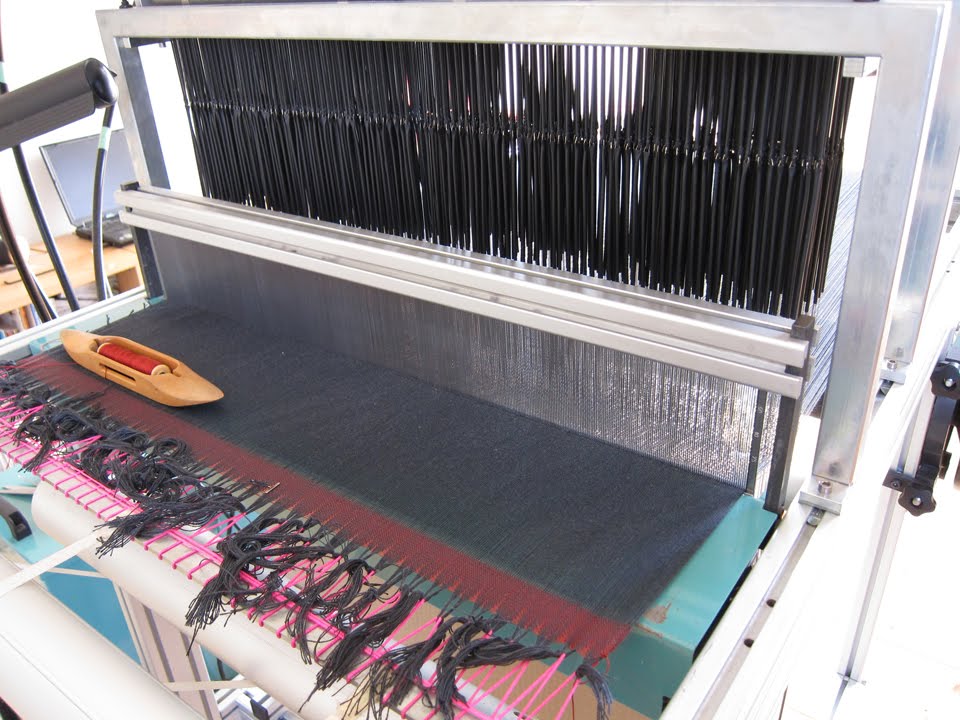
TC-1 reconfigured to 30 epi, width at reed 28.8"

Note that the cat-protector had to be modified since the box was not wide enough to fit around the reconfigured springs. I think the corrugated cardboard looks much nicer.

Recently I got a copy of Weaving for Beginners by Peggy Osterkamp. I have been reading it at night, always receptive to find a new way to do something, and Peggy has plenty of smart ideas in this book. I usually lash on my warps to tension them at the front of the loom, and she suggests using a smooth slippery yarn, like a chalk and mason line nylon. A cry to Mark and immediately I had this hot pink nylon in my hands. It has replaced the cotton cord that I used to use. I am not sure it made a difference, but like the corrugated cardboard, it looks nicer.

Note the new pink cord tensioning the warp

The weaving I wove while I was debating the reconfiguration of the loom is called His Wife. I think of it as a self-portrait. It is probably the last 13.5" width weaving I will make for a long time. Now on to that big weaving.

His Wife by Bhakti Ziek, 2010