Showing posts with label books. Show all posts

Friday, October 26, 2012

Consumerism


I don’t think of myself as a consumer, but I love to shop for some things. Groceries are top on my list. Did I write about this before? How I came home late one evening from two years living in Guatemala and Mexico and immediately went to the grocery store and walked up and down every aisle. I just starred at all the boxes of cereal, all the types of cookies, all the cheeses, and all the fruit and vegetables out of season for that area but available to purchase anyway. These days I don’t go up and down every aisle, in fact I never go past the boxed cereals or canned vegetables, but I still love going to the supermarket and slowly going through my list. I try to limit myself to a written list, but never manage to succeed. Besides the monthly bills that must get paid (like the mortgage), the grocery stores get most of my money. When times are rough, I ask Mark to do the shopping. He sticks to the list.

The other item on which I spend money is books. I used to buy textile related books. I have learned that if I see a book that looks good, I had better get it, because it won’t be there next time I look. The bookstores in Santa Fe always had something to tempt me. One memorable trip there, a fantastic bookstore was going out of business, and we flew home with armfuls of heavy art books. That was before the airlines started to charge for luggage. The books stay with us, from house to house, as we crisscross the country. They fill shelves in almost every room. Sometimes I don’t take one off the shelf for months, but when I do, it is like visiting an old friend.


 I go in cycles of topics. Indonesian textiles were high on my list for a while. In fact, almost any book on ethnographic textiles will catch my attention. These books are usually filled with lots of photos, and admittedly, I have looked at the pictures more than I have read the texts. I also like how-to books on weaving. No book has come close to Deborah Chandlers’ Beginning Weaving, one of the first books I owned, but that doesn’t stop me from buying all the ones that have come out since hers, explaining how to wind a warp, or set up a loom, or weave simple fabrics. There is this thing that comes over me when I find one of these books—I think it is called greed. I just have to have it. It’s as if my life will not be complete unless that book is put on my shelf. This hasn’t happened in Vermont because I have never seen a book on weaving that I don’t already own in any of the bookstores here.


 Lately cookbooks are calling to me. There used to be a Borders within a half hour of my house, and I would loose myself looking at all their cookbooks. Now I find I am creating quite a long wish list on Amazon; books on chocolate are piling up fast. I haven’t actually made any chocolates yet—but I am reading about them—and lusting after more books on them. Reading is definitely less fattening than making and eating, but I know that soon I am going to start…and then my list of needs will increase to molds, and dipping forks, and exotic ingredients. Cookbooks always seem to lead to purchases of kitchen tools.


 Desire is an interesting phenomenon. I can thumb through dozens of books and put them back on the shelf without a flicker of interest—but suddenly, when something catches my fancy, it seems like dozens of others are suddenly enticing. I have some control, so I whittle things down to one or two purchases, which then trigger a delayed action. Sooner or later I will be back to get the others. I have rationalized some of it. A book on weaving or cooking is something you return to again and again. It isn’t an item you can get from inter-library loan because you never are quite finished with it. Even if it isn’t a very good cookbook or textile book, still you might need to use it again in the future; and if it is a good cookbook or weaving book then you definitely will need to use it again. These are research items. Research is such a respectable word that allows me to indulge in consumerism. Mark thinks I should do some weavings based on cooking. Now that will really legitimize my research.

Wednesday, September 5, 2012

Repetitive Motions

This has been the summer of repetitive motions. You might leap to the conclusion that I am talking about weaving--the rhythmic throwing of the shuttle from one selvedge to the other, feet alternately depressing pedals--but I am talking about scraping paint off the house, painting on primer, painting the first coat of color, then painting the second coat. Of action that seems like it is going nowhere but suddenly a new view pops into focus. The last week or so it seems the house really is looking different.

Summer house work in Vermont
That's Mark's woodpile at the bottom, referencing the Green Mountains of Vermont. Stacking the wood started the summer work. After some attempts to avoid the house painting (successfully ignored for several years) we just bit the bullet and started scraping. What you can't see are all the clapboards Mark had to replace, or the rotting window frames he fixed, or that the steps are new and include a poured cement step. In other words, what he has done looks so good that you don't notice how much he has done. It's like that with art too.

Garlic from Tunbridge Hill Farm, Tunbridge, VT
It's like that with the garlic we have been peeling for the last month and will continue through October. I never realized that the bulbs I have purchased in the past, white and clean, had to be carefully peeled to remove the dirt in which they grew and the outer stained layers so that the customer could purchase the illusion of pristine bulbs. So, in exchange for our CSA share, we have put peeling garlic into our summer routine. Scrape, scrape, peel, peel. Read.

I am reading Simon Schama's Landscape and Memory. Recommended by a friend, it made my eyes sparkle from the very first sentence. I am trying to understand the myth of place, and this author, who addresses it, along with fascinating, meandering discussions that others might ignore but that he, happily, feels it necessary to explore in order to complete the idea he is addressing. Big old Victorian houses that need painting every year and garlic bulbs and local food are part of the landscape of Vermont. What parts of the illusion do I cherish and want to keep in my life? What parts seem like the DisneyWorld Pastoral Ride to me? It seems many of the places I have lived have strong identities ("Santa Fe" evokes a rich tapestry of images that are quite distinct from the equally rich tapestry of images evoked by the word "Vermont"). When I look at a map of the USA I realize that ideas of place keep me from considering many states as home. In fact, right now, I think the lack of a myth about another place is keeping us stationary.

Elin Noble and friends at her exhibition at Colo Colo
Stationary, not immobile. Just had a wonderful day with a friend driving down and back to New Bedford to see Elin Noble's inspiring exhibition at Colo Colo Gallery. These small marbled pictures are worlds within worlds, swirling energies of macro and microcosm, everything contained in nuances of black and white.

Garden Spirits by Lasse Antonsen at Slocum's River Reserve
We also got to visit the Slocum's River Reserve to see Lasse Antonsen's installation of Garden Spirits. Eeire forms, part tree, part insect, part alien figure, the installation is a wonderful start of a career change where Lasse has exchanged his curator's hat for that of an artist's. I am sure this multi-faceted creator is actually going to be many-headed continuing as writer, teacher, artist, explorer.

Amaral's in New Bedford, MA
What we didn't get to do was shop at Amaral's or walk the beach at Horseneck Beach--both priorities on the trip but proof that things are not in our control. However, I was able to get some Portuguese food items at Marketbasket--needed because the current Dowdy Corners Cookbook Club selection is David Leite's The New Portuguese Table. I made his green soup last night and it was delicious--perfect for these early fall days that seem colder than they are because they are in such close proximity to the glorious warmth of summer. You know I am not a cold weather aficianado, but I admit that I am ready to put away the scraper and pick up a shuttle, exchanging one repetitive motion for another.

Saturday, August 25, 2012

Look Again

Dowdy Corners Cookbook Club
I joined the Dowdy Corners Cookbook Club! This might not seem newsworthy to you but it shows a shift in terrain for me. Holly Jennings (third from left in the photo above) is the founder of the club--amazingly patient cook (read her past posts), photographer, and alumni of same graduate school as me. That's how we met--introduced via email by a mutual friend from school. I couldn't quite believe that someone else from Cranbrook had moved to this small town, but she had. When we first met, and she told me about the cookbook club, I was definitely interested in joining; but that was a period when I was pulling back from everything. I remember telling her that I had a tendency to join and then quit, so I would save us both the trouble and just not join. That was several years ago, and though I didn't join, I did read her blog and even bought one of the books and cooked from it.

Holly and Wendy (second from left in photo above) stopped by our porch during the town's July 4th parade and Wendy was very enthusiastic about the cookbook club and encouraged me and Marianne (left in photo above) to join. Suddenly it made sense to me. I love cooking (sometimes). It is one of the few things that really gets my attention these days, and I want to learn more about it, I want to get better. I even want to go back and get a degree in baking, though I doubt I will do that. So I said yes. And then I did it. I actually signed up on line and bought the current selection, Ripe by Nigel Slater. In fact, I actually bought a different Ripe first--amazed that it was so much less expensive at Jessica's Biscuits than on Amazon--not noticing that it was a different price because it had a different author. Both books are pictured above.

I think of Slater's book as a non-recipe book. It is a beautiful book--inspiring pictures, luscious words, and simple instructions. Sort of, wash a peach and eat it. But I used it (and Cheryl Sternman Rule's book) for many dishes (his blueberry pancakes made with ricotta cheese are excellent, and once I made them with glutton-free flour and they might have been even better than the first round which were also delicious) and felt that both books had something to offer. But when I went to the pot luck last week I was amazed at how wonderful the meal was--how every dish enhanced the other. Nothing was too sweet. Everything tasted fresh and satisfying. I think the other people (Melanie is 2nd from right, and Tamara is on the right) all felt the same. Maybe this book (Slater's) has more to it than I gave him credit for. I can't wait to read Holly's evaluation on the blog. By the way, she encourages people from other areas to join, and to start their own group for potlucks. I love the idea of communities of cooks gathering together all over the country comparing dishes they made from the same book.

I often don't spend money on anything except the monthly bills (boring and annoyingly regular) but I do spend money on food shopping and books. For awhile now I have managed not to buy books--and the Kimball Library here in Randolph is fantastic about getting books that are requested (and the staff are super excellent)--but I admit that a perk of joining the club is that I now can legitimately buy cookbooks. I have to--library loan just won't do for something like this (so I say). You should see my wish lists on various sites (but I think I made them private).

Beyond Craft: The Art Fabric by Mildred Constantine and Jack Lenor Larsen
(Top Right: detail of Space Hanging by Lyn Alexander; Middle Left: detail of Orange Weaving by Olga de Amaral; Middle Right: detail of HUM by Susan Weitzman; Bottom Left: detail of La Visite Di Aldebaran by Jindrich Vohanka, Bottom Right: detail of Raumelement, Yellow by Moik Schiele)
I had a visitor the other day who had some questions about fiber processes and during the discussion I pulled out my copy of Beyond Craft: The Art Fabric by Mildred Constantine and Jack Lenor Larsen. Most of you know this was the first definitive book on fiber art. I have looked at this book hundreds of times. Some works, like Susan Weitzman's HUM, have always left me breathless. She is one of those mysterious artists who made such an impact on people but who removed herself from the spotlight, something else drew her attention. But what she contributed has withstood the decades of change since she made that work. It still pulls me in and holds my attention. Other works are just invisible to my eyes and sensibilities, though I recognize their ambition and creativity.

But I must say, this is a time to pull that book off your shelves again and look through it. It is full of the most amazing work, by artists who truly were pioneers, working with materials in ways no one had thought of before and in a scale that is, even now, mind-boggling. I have just put a few details of works above, pieces that have great subtlety, simplicity, imagination, and skill. None of them tell stories per se. They are not the works that would have attracted me (except Weitzman's) when I first saw the book. But WOW--they sure look interesting to me today. And of course, the great tragedy, in this current time of anything goes--where fiber seems to be the material of choice for many young artists--the works in this book are not known. So pull that book off your shelves and start showing it to everyone you know who says they are interested in art. It really is a book that has retained its relevancy.

Nomad (Panels 1, 2 and 3) by Bhakti Ziek, 2010
Just a final note to say that I have completed re-finishing my six panels of Nomad. I don't have a wall large enough to photograph the six panels together so I had to do it three by three. No lights either, but....The Fuller Craft Museum has posted the exhibition information: Grand Tales of the Loom: Four Master Weavers. The exhibition will run from September 22, 2012 through January 20, 2013. There will be an artists' reception on Sunday, September 30th from 2-5 pm and all of us (myself, Cyndy Barbone, Deborah Carlson, and Fuyuko Matsubara) will be there. The four of us "came of age" as artists in the 1980s, a generation after the artists in Beyond Craft. We stayed with the loom, really mastering its possibilities, rather than working away from it, as did most of the artists in that book. We had our own "time" and as artists and teachers, we influenced others. I do hope this show will again prove that working at the loom in a careful, thoughtful way is still relevant.

Nomad (Panels 4, 5 and 6) by Bhakti Ziek, 2010

Okay, one comment more about Joan Didion's book, Blue Nights. I read the book straight through yesterday. At the back of the book, a library book, was a page where readers could leave comments. The first commenter felt she had never encountered a more self-centered woman, and added, "get a life." The second comment noted how sad the book was. I wasn't going to add anything but just couldn't help coming to Didion's defense, so I added something to the effect that she talks about truths that others want to ignore, deny, or hide from. The loss of her husband and daughter within 20 months of each other is almost too sad to bear. The way she keeps repeating certain phrases over and over reminds me of the way our minds gloam onto something and get stuck, the way records used to do. A life full of memories but always the same few come back to haunt us. And her writing about aging, so stark and honest, is almost terrifying. I note in my own life how 66 is nothing like I imagined it. It is both better and worse. And honestly, I don't think my friends who are younger can understand until they get here. I might think I am 12 inside, but when the young man at the liquor store tells me I shouldn't waste my money on an expensive (we are talking $20 here) bottle of wine because "older people can't taste things anymore" I admit that I am shocked at both his rudeness and the fact that he sees me as old. So Didion's experiences of vulnerability and insult are ones I can hear. I haven't read much by her, but I found this book compelling. And the shift of terrain I mentioned at the start of this post is something about aging, and finding new ways to engage with the preciousness of time.

Wednesday, April 27, 2011

Report on Road Trip -- Part III

Beautiful Washington D.C.

Washington D.C. was showing all its beauty last week, and I was thrilled to have a strong fix of urban energy. One stop was to see the work of Ford/Forlano who were exhibiting their incredible jewelry in a small show downtown. I might not wear jewelry myself, but I am always inspired by the creativity of Steve and David. We also stopped by Hemphill Fine Arts to see the current exhibition and catch up with one of the directors, Mary Early, whom I met in Vermont recently. Mary's sculptures were featured in the January/February 2011 issue of Sculpture Magazine. Next time I am in D.C. I will definitely make time to visit her studio.

I was very concerned about the potential government shut-down (not just because it proved that politicians think life is a reality TV show and the public so stupid that they can't see through their cliff-hanging-wait-to-the-last-minute shenanigans) but because I really wanted to get to the Hirshhorn Museum to see the Blinky Palermo exhibition, and of course all the Smithsonian Museums would all be closed if the government was shut down. Mark has mentioned Palermo to me for many years, and he particularly wanted me to see the work shown in the image below (which I found on the web since I wasn't allowed to photograph in the exhibition itself). When I walked into the room I thought they were paintings, but in fact they are dyed cloth impeccably sewn together so you hardly notice the seam lines. Beautiful nuanced use of color, and a very innovative way to paint back in the late '60s. Even today it would be considered innovative (in any other world except the textile world). Another contemporary artist who works with fabric but is not defining himself in terms of textiles is Sergej Jensen.

Fabric paintings by Blinky Palermo

One of the things that really delighted me about the Palermo exhibition was that they gave the work the space it needed. In one room, there were four small cubes of color attached to a corner, two on either side of the wall joint. That was it. It just thrills me to see work displayed like this. On my way home, I stopped for lunch in Philadelphia with my friends Michelle Liao, Meg Richter, and John Struble. We had a delicious beet salad in Michelle and John's loft, which is above Michelle's store, the Liao Collection. It also happens to be blocks from Chinatown. So I was impressed that I enjoyed the salad so much (so much that I made it for Mark's birthday a few days later) that I didn't kick and scream about not having dim sum with them. Maybe it was because hanging out in that loft is like going to the museum--there is nothing redundant or frivolous in the space. Every object is perfect, and they are placed so the whole is about air and light and beautiful energy. I love these three people so much that I could weep every time I think about leaving Philadelphia and our weekly dinners together. What is incredible though is that life has brought important changes to all of us, but the heart connection is still so strong and vibrant. A trip back to Philadelphia is definitely in the works.

Philadelphia Friends: Meg Richter on left, Michelle Liao in center, John Struble on right

I drove from Philadelphia to Greenwich, NY without problems--but arrived at my friends Cyndy Barbone and John Golde's home in the dark. I must have driven up and down the same stretch of road six times before I finally parked my car in someone's driveway and got out to try and find a house number. I found one four houses down from my car--and when I counted back, it turns out I had pulled into their driveway. Cyndy is an amazing weaver. She usually makes narrative panels that add up to a story about light and spirit. A visit to her studio the next morning showed some of those, as well as fabric being woven on her loom that will become a winter coat. Since Cyndy has visited us in Vermont a couple of times, I was so glad to reciprocate and see her place. It is really rather close, so I imagine we will see more of them this summer.

Cyndy Barbone with her weaving and Peanut on the left;
work in progress and sample woven and shrunk on the right

So that pretty much covers my amazing, energy-filled trip to Maryland/D.C. area. While I think about it, I want to mention a book I just finished: Seven Days in the Art World by Sarah Thornton. It is not the art world that I know. In fact, I doubt if anyone I know on a day to day basis is part of this art world--but it is a world that influences all of us, and perhaps what we aspire to (sort of). It describes a type of collected work that is beyond my sense of ambition. I keep thinking, how could I possibly return to the loom and make new work if one of my pieces sold in auction for 2.5 million dollars yesterday? I would be paralyzed with doubt. It would be out of all proportion to the sense of exploration that I need when I go in the studio. In order to work, I have to allow myself to fail, but if I had those kinds of expectations surrounding my work, I would certainly fail because I couldn't start. That said, I am excited that one of my most ambitious weavings is going to be on exhibit in Barre, Vermont at Studio Arts Place. I am not sure where it was seen, but someone who saw the piece on line (I think) suggested to the director that this work would fit the theme Refuge. I liked the idea, not just because the weaving forms an enclosure, but because it also has references to the Buddhist Wheel of Life and has an image of the sleeping buddha on one of the panels. Buddhists often "take refuge in the Budhha, the Dharma, and the Sangha." My weaving, Wheel of Life: The Passing on of Knowledge will be on view from April 26th to June 4th.

Exterior Views of Wheel of Life: The Passing on of Knowledge by Bhakti Ziek

Thursday, December 9, 2010

Reconfiguring the TC-1

TC-1 with 4 modules, 60 epi, 14.4" in reed

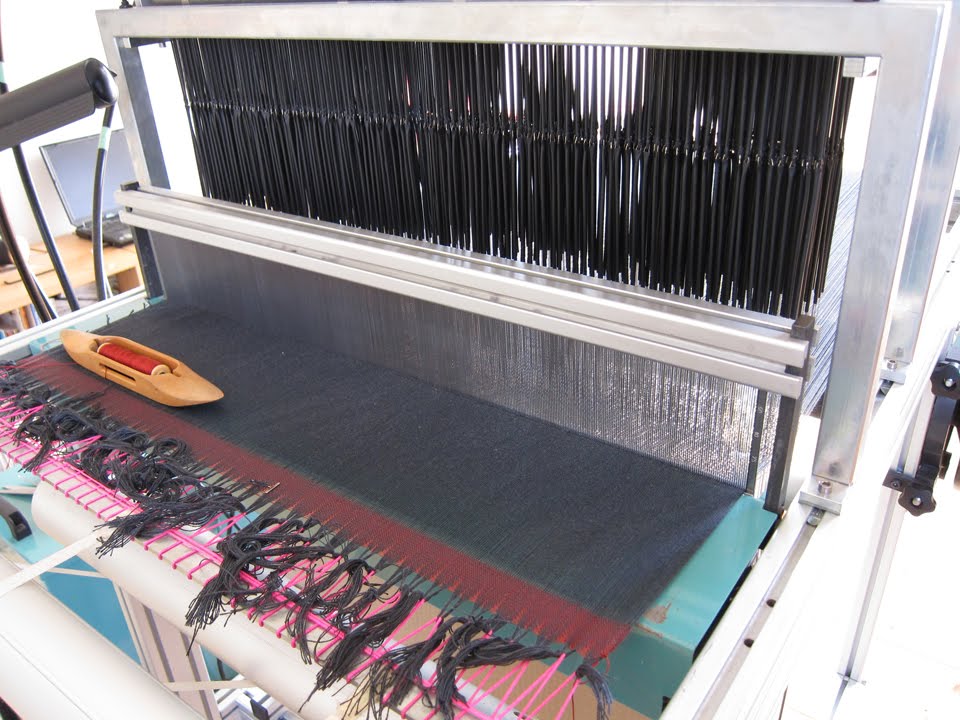
I have always been weaving on my TC-1 (Thread Controller 1 Loom from Digital Weaving Norway) loom with four modules set up one behind the other, giving me a warp density (sett) of 60 ends per inch (epi) and a weaving width at the reed of 14.4 inches. Since the interlacement of warp and weft (weave structures) brings the warp in, most of my final work has averaged 13.5 inches in width. You can see the loom above from different sides. Note that the cardboard box is my own invention--cat-proofing the springs and heddles. I had it in my head that I would do a large weaving for my upcoming show (two-person exhibition at the Chandler Gallery) if I had the time, and, if so, I would reconfigure the loom to weave full-width. This would mean I would have a width of 28.8 inches at the reed, but my sett would decrease to 30 ends per inch.

When I finished my sky weavings--East and West--which I love, by the way, I started debating with myself--leave the loom alone or take a chance on reconfiguration? Everything was working so well, did I want to rock the boat? Would I have time to complete a piece? Did I have enough warp (it would have to be heavier than the 60/2 silk I was using to account for the smaller sett) for the new piece? If it was possible to worry about it, I did. But I always came back to the conviction that this was the time to change the loom and weave at a larger width. Call it fate.

My in-house saint, Mark Goodwin, reconfiguring the TC-1

Of course, my reconfiguring the TC-1 loom translates to Mark reconfiguring the TC-1 loom. You'd think it was enough that he has made all the beautiful frames for mounting my new work, but there is always something else I can think of to ask him to do. (Do you know that expression, honey-do?) We were greatly aided by a video clip of the process that Vibeke Vestby, the inventor of the TC-1, sent to us. We (I did help) had to remove the modules, put two of them together, replace them on the loom, modify the bottom slides that hold the springs, and basically we were done. It was amazingly easy and I could move on to my next fear--rethreading the loom.

Because the modules were moved, I had to completely rethread the loom. First we had to take a trip to Massachusetts to buy new yarn (I am using 20/2 silk from Webs) (now I can worry about my credit card bill), then I wound an 18 yard warp (my longest ever) and I put it on the back beam. In the past I used a quarter-inch raddle--but that left my hands when I sold my AVL dobby loom--so I used a one-inch raddle and knew the whole time I was doing it that it wasn't right. My back beam has flanges which need to be placed at exactly the width of the warp, but I had mine wider. Don't ask me why I didn't stop and get it right--I just didn't. Then I threaded the loom. There are 880 hooks on my loom, therefore 880 threads, and after a while I got a rhythm going--count out 10 heddles from the bottom spring bar, count out 10 threads, thread the heddles. Tie them off to the right. Untie ten threads from the group tied off to the left. Start again. If you read this blog regularly you already know that counting and numbers are a big part of my life, and repeating actions are basically the life of a weaver.

The threading went smoothly too--another worry hits the dust. Threading the reed was really simple--I just made a weave file that lifted two ends at a time and ran through that file putting the lifted ends into the dents of the reed. Then I pulled the whole 18 yards forward through the reed, called for Mark's help, measured and repositioned the flanges correctly, then slowly and very carefully wound back the warp under even tension. It looks great now.

TC-1 reconfigured to 30 epi, width at reed 28.8"

Note that the cat-protector had to be modified since the box was not wide enough to fit around the reconfigured springs. I think the corrugated cardboard looks much nicer.

Recently I got a copy of Weaving for Beginners by Peggy Osterkamp. I have been reading it at night, always receptive to find a new way to do something, and Peggy has plenty of smart ideas in this book. I usually lash on my warps to tension them at the front of the loom, and she suggests using a smooth slippery yarn, like a chalk and mason line nylon. A cry to Mark and immediately I had this hot pink nylon in my hands. It has replaced the cotton cord that I used to use. I am not sure it made a difference, but like the corrugated cardboard, it looks nicer.

Note the new pink cord tensioning the warp

The weaving I wove while I was debating the reconfiguration of the loom is called His Wife. I think of it as a self-portrait. It is probably the last 13.5" width weaving I will make for a long time. Now on to that big weaving.

His Wife by Bhakti Ziek, 2010

Sunday, April 18, 2010

Just Trying To Get it Right

Lately in my lectures about my work (which is about my life, since not much is compartmentalized for me), I have noticed how often I have moved. Besides calling Mark and myself “urban nomads”, in defense of all this uprooting and replanting, I have taken to saying something like this: “I am just trying to get it right.”

This morning, as I was making my breakfast on the electric stove we inherited when we bought this house, I was mulling over the idea of learning something, and taking it into the next part of your life. After all, isn’t that what experience is for—to learn from it, so you can have a more elegant outcome the next time a similar situation presents itself? And similar situations always present themselves. In our Kansas home, year 2000, one of the first things we did was pay an outrageous amount to have a gas line put in the house so we could remove the very ugly electric stove that was there, and put in a beautiful stainless steel gas stove/oven. We had just bought a new oven for our New Mexico house (1999) but because we were off the grid, we had to buy the absolute simplest model—one without a clock, or any of the fancy regulators common on most models—a gas range that was converted to propane. Therefore, I was so pleased to be able to get what I wanted in Kansas, my new stainless steel range. However, I don’t remember it cooking or baking very well. Nothing extraordinary there, except it did look pretty.

Electric Range

Here, in our Vermont house (2008), we have a contemporary white electric range with the glass stop—no more tipping burners that disconnect in the middle of cooking (Arizona, 2007). If I want to have gas, as I was sure I would, then we have to go with propane again—but here I can get the fanciest model, whatever I want. Right now it is low on our list of priorities—a new efficient refrigerator would come first—but I am finding out something interesting. This is the best oven I have ever had. It bakes cakes perfectly. If a recipe says 350 degrees for 30 minutes, then the cake is done exactly at 30 minutes. I can even stir-fry on the glass range and things sizzle in minutes. Each day the stove’s place on the wish list drops further down. Will I request a similar stove in my next home (20??)—I don’t know. I certainly will be more open to possible solutions, depending on the circumstances.

So what did I make for breakfast? Cream cheese and lox on a tortilla. A combination of experiences from different parts of my life: cream cheese and lox from growing up days on Long Island (1950-60s), tortilla love from Guatemala (1970s). Getting it right doesn’t always mean doing it the same way. In fact, it usually means learning something and modifying it for the present circumstances. Like stopping at Trader Joe’s on my way home from Massachusetts to buy a freezer bag full of their frozen potstickers. Would I choose these if I were in New York City? Of course not—I would be down at a dim sum restaurant right this minute gorging on my favorite food. But what a treat in Vermont to be able to open a bag of these frozen dumplings.

Breakfast

I am almost at the end of a very interesting book called Journey of Souls by Michael Newton. It is non-fiction, but many people would call it fiction. Apparently he has written four books and this is the first. I am fascinated by what he writes, not sure where I fall on the fiction versus non-fiction. Okay, I lean more towards non-fiction. He is describing the place where souls reside between lives. The funny thing is what he has them doing there—they are studying and learning. If true, then I think I will enjoy myself. Apparently we spend a lot of time looking at our past experiences and analyzing what we did, and what we could have done better, and how we can return in a new life and try those situations over again and see if we have indeed learned a better way, or not.

There is so much to contemplate from this book—whether it is fiction or non-fiction—the purpose of all good literature, right? Maybe because it is spring, but I am certainly in contemplative, analytic mode, trying to remember what I intended to do and seeing if I can get back on track. Opening my heart, remembering kindness, listening to people with love rather than judgment—these are the sorts of things I tend to forget and am trying to rekindle and restore. I know I don’t have to move to get it right; I can just get up each day and try again.

Weaving Burlap/Jute?

Meanwhile, I have all five looms threaded. I am weaving on the warp with the mystery thread that I used the McMorran Balance to determine the yards per pound. The cloth is turning out so differently than I imagined (is this a metaphor for life?). It seems I am weaving burlap. On the spool I just couldn’t see it, but looking at the cloth, I think I can determine that the yarn is jute. It’s weaving fast—by the end of the day I will only have four of my looms threaded.

Sunday, March 7, 2010

Goodbye Loom

Last project on dobby loom

Yesterday we said goodbye to the beautiful dobby loom that took center stage in our front room. The first step in disassembling the loom was to cut off the yardage that was on the loom. I laid out the damask block section on the table and am relieved to see that it is long enough to go edge to edge. I hope after washing it will still cover. Now the front room is empty, encouraging us to bring the sofa from the second floor office downstairs to be more useful.

Thank you to everyone who sent me comments on my last blog post, many of them came in direct emails to me. They all were thoughtful and encouraging. I have been rereading Jack Kornfield's wonderful book, A Path with Heart, and, honestly, I want to underline every sentence. It is reminding me that each of us has to forge our own way, authentic to ourselves. As soon as I wrote the last post, I knew that I had already come to some decisions--like focusing on weaving work for an exhibition, and not letting other things interfere with that commitment. I will have to finalize the first work soon, since the Vermont Weavers Guild is coming to see my studio on Saturday.

If you are on Weavetech (a yahoo group) or the Complex Weavers Jacquard Study Group, you already know that Garth Fletcher, the developer of JacqCAD Master, a software specifically for jacquard design, has announced that the program is now available as shareware. He explains it all on the website. When I taught in universities, this was one of the programs I used, and I had created and saved hundreds, maybe thousands, of weave structures in that program. When I left academia I no longer had access to any of that information--and it is one of the reasons I was interested in developing Photoshop for jacquard (see The Woven Pixel for those results). With my impeccable sense of timing, about a month ago I cleaned up the two computers that had all my JacqCAD files on them and threw those files into the trash! Oh well. I probably won't go back to that program, since I am quite satisfied with my method of designing and weaving using Photoshop, but it is an excellent program and Garth has offered a gift to everyone in the field.

I want to mention the Osloom project again. I like the spirit of this project. It is an attempt to open up new technologies in weaving to a larger group of people. I also want to say that I suspect that as that project unfolds, they are going to discover that the high cost of the current hand jacquards is due to the expense of manufacturing parts that are specified to the tiniest fractions of variation--and anything less than that will cause problems with the loom. Vibeke Vestby began her investigations that led to the TC1 with the same spirit of innovation and sharing that Margarita Benitez has for the Osloom. The expense of the loom has not increased because of greed but because of the value of the dollar versus the Norwegian krone. Despite the headaches of manufacturing, Vestby and her company have continued to improve the loom, and continue to offer the best customer support possible. As I return to my TC1 this week, I know for certain that I will be sending silent blessings off to Vestby, in gratitude for all she has done for me and other weavers. In that spirit, I wish Benitez support for her project, and hope you will donate to her kickstarter project. If enough of us donate $25, it can add up to the sum she needs.


Thursday, January 7, 2010

My Almost Perfect Life

Final Version of Curtains

I finished the new central curtains yesterday. As you can see, the panel in the very center has a seam through it. I was using a pin to measure the lengths of the panels--so I would hang the yardage, put a marking pin in the cloth, return to my sewing machine and sew two parallel zigzag lines that allowed for turning under the cloth so the pin would be at the bottom hem, and then cutting the cloth between the zigzag stitched lines. Then I turned under the hem, sewed it down, ironed the cloth, and hung it. Much to my chagrin, I discovered the length was too short. Now how did that happen? I went back to the remaining yardage and found another pin in it--at the place where the length would have been correct. Obviously I must have left one of my marking pins in the yardage, the ones I use when measuring the cloth on the loom. How annoying!! Now I am not a perfectionist by any means, but I do like to get things right, and this mistake really upset me, even though I quickly resolved that I would add the additional fabric to the panel and live with a central seam.

Detail of a Korean Pojagi

Then Mark brought over one of my books on Korean pojagi and showed me the page above and said, "Look at all the mistakes they made!" I laughed and laughed and felt better about myself. I have two excellent books on these wonderful Korean wrapping cloths--Patterns and Colors of Joy: Korean Embroidery and Wrapping Cloths from the Choson Dynasty and The Wonder Cloth.

Wooden Collage by Mark Goodwin

Once the curtains were up, we changed the art work that was over my grandmother's desk to the wooden collage, shown above, that Mark made. The whole room is so pleasant and inviting now, and I am glad to be able to check off one project so early in 2010. I am trying to get myself more organized this year, so that my studio work takes priority over everything else. Sometimes in the evening now I will make a list of what I hope to accomplish the next day--and even if I don't write it down, I tell myself my intentions so I can prepare myself to get to work. I have a lot of small projects I want to finish--one is a vest I started knitting for Mark about eight years ago (honestly, I don't really know if it was 8 years or 4 or maybe 12--but it was a long time ago). But before I pick that up, I am trying to finish a double hat that I am making for myself. You knit one hat and then continue on to the other, and when done, you push one inside the other so it is double thick, warm, and reversible. I am being spurred on by the fact that I lost my hat and gloves on New Year's Eve.

Knitted hat project in process

Another project I am working on is the long heavy white cotton warp that is on my wide Macomber, where I am weaving dish towels. I am putting borders of turned twill blocks at both ends of each towel, and the body is plain weave. I think I put a 10 yard warp on the loom. Maybe I was crazy, but this is part of my thinking about money and being a weaver. Maybe it even has something to do with living in Vermont, where it seems many weavers make lovely, simple, functional textiles. Or it has to do with my sense that I want to understand all the facets of what it means to be a weaver and production weaving is something I have not explored. So I thought I would make a commitment to a product and limit myself to only that, and see how I fared. So far it hasn't been a project that generates much energy for me. I guess I am not good at repetition. However I have found by telling myself that I should do one or two towels a day, as a reason to get up to the studio and be in it, sort of creating an energetic path up to the studio, I am moving through the warp. I am also telling myself that this is the start of a body of woven work that will be affordable for people who might like my work but not be able to purchase my art weaving.

Detail of cotton dishtowel

Like many people in this country, the flow of income has slowed to almost non-existent in our household. I keep trying to think of ways to generate more money, many of which involve this blog, but a long-held idea that my work should be separate from money has been a hindrance. I have never wanted money for money's sake, and even today I think my needs are modest--I want to be able to pay my monthly bills on time, I want to be able to buy whatever groceries I want (now that might be extravagant), and I want to have a small cushion in the bank so I don't worry about checks clearing. When I was younger, I was told that if I planned to make my living as an artist I would have to do lots of activities to have income add up--sell work, do lectures, teach, write--and I have done all these things. Only when I taught full-time, did I not have to think about income. When we moved to Vermont I figured my reputation as a teacher and artist would be enough to bring in the money needed for living. It is close, but not enough. I had wonderful tutorial students come study with me in 2009, but no inquiries yet for this year. I really enjoy these one on one learning experiences, so if you are interested, please contact me.

Another idea I have had was to put an older work on my blog, one a month, in a silent auction format. I could let people know the retail value of the work, but also make it clear that I would accept the highest bid of the month for the work. Friends have encouraged me to do it, but I have been embarrassed or, as I said above, hindered by my ideas about money, to do it. Why should I feel this way about selling my work? I love it when people buy a weaving and live with it and find joy in the work, I just don't like to think of the work as a commercial product. Since this is a new year (HAPPY NEW YEAR to all of you!), I am going to try to change my mindset so I can be turned on to making money. So let me say boldly that all of my weavings and all of Mark's drawings and sculpture are for sale. If you are interested, please email me for prices.

Also, I am going to end this post with an image of one of my weavings, Felted Study #2, woven in New Mexico in 2003. The felted weaving is sewn onto cloth, that is stretched on a frame and measures 18" high and 22 " wide. The materials include wool, cotton, chenille, boucles, and natural dyes. I used coffee, logwood, and indigo on the warp, and wove it as a lampas pickup. After weaving, I fulled the cloth. Because the various materials had different properties of shrinkage, the diamond forms became dimensional. It was previously offered for sale at a retail price of $2800. Today I will offer it as my first silent auction weaving, with the caveat that bids must start at a minimum of $300. If you are interested, please email me with an offer. I will notify bidders throughout the month of what the current high bid is, if it is higher than theirs, or maybe I will add the auction to the sidebar of my blog.

Felted Study #2 by Bhakti Ziek

Saturday, December 19, 2009

Halifax - Part 2

Halifax Night Lights

Halifax was lit up for the holidays, as well as the usual city lights, but pictures taken in a moving car in snow and rain show it off even better. Last time I was in Halifax there was a fierce snowstorm that shut down the enter east coast, causing a two-day delay in my arrival. School (Nova Scotia College of Art and Design, i.e., NSCAD) was cancelled but some students came in anyway to hear my talk. There was no traffic on the road, snow was knee deep, and I thought the town was a small fishing village. This time I realized it is quite large--especially if you consider Dartmouth and Halifax as one city. I liked everything about it and hope to get there in warmer weather when we can walk along the water and not freeze.

Lesley Armstrong in her studio, Armstrong Textiles

I met Lesley Armstrong on that first visit to Halifax and knew I wanted to see her studio. Lesley produces wonderful contemporary textiles that are woven and then felted and manipulated to become textured and lively. She weaves these fabrics on old looms that she has saved from disuse, bringing some of them from England to Canada. I loved the contrast of the up-to-the-minute cloth with the machinery, which is really industrial revolution (ancient compared to modern equipment). You can see that Lesley is as lively as her cloth--always laughing, smiling and exhibiting genuine enthusiasm. Besides running Armstrong Textiles, she is on the faculty of NSCAD.

Robin Mueller (l) and Frances Dorsey (r)
Textile Faculty at Nova Scotia College of Art & Design

Images of NSCAD Textiles Studios
Morag weaving on tapestry loom, top left
Michelle Alarie at TC-1 Loom, center left
Maddy Andrews wearing her jacquard cloth, bottom right

Robin Mueller and Frances Dorsey are the two full-time faculty in textiles at NSCAD. Although it was the end of the term, and everyone was very busy, they kindly asked me to do a lecture for their students. Before my talk I got to visit the studios, which are in a charming old building, one you could easily get lost in. Michelle Alarie, the technical assistant, was my guide and kept me out of trouble. They have a wonderful TC-1 loom with 12 modules. I wove on it the last time I was there. This time I only looked with envy at the width and the extra modules that i would like to have on my loom. There is a strong possibility that I will return to NSCAD in the summer of 2011 to teach, and perhaps there will be a chance for me to try their loom again too. NSCAD has been a strong program for many years--Sandra Brownlee is one of their graduates. One of the reasons it continues to thrive is because the faculty are working artists, as well as teachers. If you click here you can read an interesting review of Fran's recent exhibition, Saigon. There is also a catalog that can be ordered from the exhibition. Though I don't know Fran well, every time I see her I have the feeling that we are old friends. I guess we must have been sisters in a past life.

Wendy Landry in her studio showing her velvet loom

Another woman who teaches at NSCAD is Wendy Landry. We visited Wendy's studio on Saturday. I knew she was a velvet weaver and had modified a loom, but I wasn't familiar with her work. Once I saw it, I thought that not only should I know her work, but so should more people. She has her loom set up with two different warps for the velvet pile so she can do interchanging colors in pile. She is also a historian and scholar, and her interests show up in the weaving. The bottom left image above shows a weaving she did where she combines pile loops and an area of weft tapestry, like the Coptic weavers used to do.

Sandra Brownlee weaving and images of her studio

Of course, we also saw Sandra Brownlee's studio. Sandra's work is featured in the new book, Art Textiles of the World: Canada. So if you can't get to Halifax to see her current exhibition, you can see her work in that book.

Speaking of books, if you are looking for a gift for someone who loves to read, I strongly recommend A Pigeon and a Boy by Meir Shalev. It is one of the most beautiful books I have read in a long time. Bittersweet. It made me want to visit Israel. It got me to write to my wonderful cousin Ahinoam, who I had not contacted in a long time. It's a great read.

I finished my plain weave linen for the curtains. Will take a picture soon to show you the moire effect. I didn't get to light Chanukah candles this year (Happy Chanukah if this is your celebration!) so this tree below will have to do.

Festive Halifax Tree