Showing posts with label jacquard. Show all posts

Thursday, August 30, 2018

Website for New Work

If you follow this blog, you probably realize I haven't been using it very often. I will leave it in place, but if you want to see my new work, or know what I am up to, please visit my website:


or check out my Instagram site:


And thank you for your interest in my work.
Bhakti

detail of 2018, by Bhakti Ziek, handwoven jacquard (this detail is samite)

Sunday, October 30, 2016

Lexicon -- An Exhibition of Weavings by Bhakti Ziek

I have a new exhibition up at BigTown Gallery in Rochester, VT from October 26 - November 26, 2016. It is called Lexicon and includes new weavings as well as some older ones. I have posted images on my Facebook page but will put them here too.

The Refuge series (1 - 8 shown below) are all 8"h x 6"w, woven using taqueté or plain weave structures, composed of seine twine warp (hidden) and wool, rayon chenille, and metallic yarns.

Refuge 1

Refuge 2

Refuge 3

Refuge 4

Refuge 5

Refuge 6

Refuge 7

Refuge 8


Taqueté Bands, Taqueté Rabbit and Samit Duck are part of the didactic series about structures. Some of this series could not be shown, due to space considerations, but I will put them at the end of the images.

Taqueté Bands
29.5"h x 15.5"w, 2016

Taqueté Rabbit
18"h x 26"w, 2016

Samit Duck
16.5"h x 26.5"w, 2016
I wove Florence Cross-Sections and Birds 2 in the summer of 1997 at Fondazione Lisio. They are both damask liserie, one woven by hand (Birds 2) and one woven on a fully electronic loom at Rubelli Silk Mills.

Florence Cross-Sections
31"h x 46.5"w, 1997

Birds 2
9.75"h x 7.25"w, 1997

Quote is the beginning of a series that I still have to weave. It is samitum structure; a motif handpicked on an 8 shaft loom based on a historical textile.

Quote
3.25"h x 3.5"w, 2007
Mark Goodwin made a vitrine for me to show four weavings made circa 1990 using lampas structure and some brocading.


Detail of Pink Lampas Study
80"h x 8"w

Detail of Gold Diamond Lampas Study
69"h x 8.5"w

Lampas with Brocade
6"h x 5.5"w

Supplementary Warp Study6.5"h x 8.75"w
 
There wasn't enough wall space to hang the following five pieces, but they definitely are part of the Lexicon work.

Taqueté Structures
10.5"h x 26.25", 2016

Taqueté Sunset
12"h x 14"w, 2016

Taqueté Trees
12"h x 12"w, 2016

Taqueté Described 1
15"h x 13"w, 2016

Taqueté Described 2
15"h x 14"w, 2016
This is what the gallery says about the work:

Bhakti Ziek - Projects Gallery

October 27, 2016

Bhakti Ziek doesn’t like to be asked “what is it?” about her work. She responds, “It’s a weaving.” If she were a scientist, she would be a research scientist, freely exploring possibilities without expectations of outcomes and end use. As an artist, her favorite pieces are her studies. For her exhibition, Lexicon, at the BigTown Gallery Projects Room, she has created a series investigating three ancient weave structures: taqueté, samitum, and lampas. 
Ziek is a renowned teacher (she says her “higher self” is when she is teaching), and she often leads workshops that cover these three types of interlacement, which probably developed one from the other. Ziek likes to refer to her lineage as a thread of weavers going back thousands of years. As early as the 2nd century, some of these weavers were using taqueté to make figured textiles. Today the looms have changed, but the structures that create the cloth remain the same. In Lexicon, Ziek is attempting to bring the audience into the work by explaining how they are made.
Stitched samplers, illuminated paintings, Mughal miniature paintings, and Sassanian, Safavid, and Ottoman textiles are a few of the influences Ziek sees in her work. Letters have often been a component of her work, but now they are didactic as well as visual. She says that making these weavings has been an elusive quest—that she isn’t quite there, but hopes to get there. Then she laughs and says, “isn’t all life like that; it’s all a journey of hope.”

Thursday, April 10, 2014

Stardust

Stardust by Bhakti Ziek, a permanent installation at Whitman College, Princeton University (photo by Ed Wendell)

I have been working on Stardust (a permanent installation at Whitman College, Princeton University, Princeton, NJ) since May 2013. It was installed March 19-20, 2014. There are six panels, each 16 feet high x 27.25 inches wide. They are handwoven weft-backed jacquards made out of silk, tencel, and metallic yarns.

It was an incredible year. One that called on me to use all the knowledge I have acquired over the years related to weaving and art, and still it pushed me to new territory and insights. I will write more about it soon (relatively soon) but for now you can see more images (photos by Ed Wendell) on my facebook page if you go to this link.


Princeton University commissioned a video on the making of Stardust. It was produced and edited by Michael Sacca. Click here to see.


Monday, April 18, 2011

Report on Road Trip--Part I

Myra Serrins in her studio
Natural Dyes 1 by Bhakti Ziek on left
Woven Dyed Piece by Myra Serrins on right

My road trip to Maryland/Washington DC area was so chock full of experiences that I will have to report on it in several posts. I stopped the first night with my friends Myra and Marty--just in time to go to Myra's yoga class. She is the teacher--and a really good one too. I didn't like yoga when I did it in the 70s, and I didn't like it recently when I tried a class here, but I actually enjoyed working with Myra. It definitely felt like the perfect antidote to hours of sitting in the car. I was pleased to see a couple of my weavings hanging in their house. Natural Dyes 1 is shown above, left. I wove it in New Mexico, and the warp was ikat dyed using natural dyes. Myra is a serious committed artist (my favorite type) who works in several medium, including weaving. I love the depth of black in her weaving on the right. If you click on the image it will open in a separate window and you can see the details of it better.

Blossoms Two Ways

I left piles of snow and no traffic, but the snow was gone by lower Vermont. By the time I reached Webs in north central Massachusetts my hands hurt from gripping the steering wheel with tension. I tried to remember Mark's suggestion--just stay in your lane and you will be okay. You would never know from my fear of traffic that I am a New Yorker. The first day was the worst--then I calmed down. (And I did manage to make it home safely, so I guess everything in terms of driving went well.) The trees had fresh small leaves in Massachusetts, there was green grass in upper New Jersey, and flowering trees in Maryland. I had to go and meet Spring, since she hasn't shown up here yet.

Since I mentioned Webs, I might as well tell you that I was so disappointed with the yarn that is available for weavers these days. I needed some black novelty yarn, a boucle or something like that, and they had one shelf with some variegated yarn on cones, and nothing else. I ended up buying a few balls of expensive knitting yarn to try it, but....I really miss Irene and Cooper Kenworthy in Providence.

Tied-Weave Study Group on left
Chris Spangler, Lanna Ray and Caroline Harlow on the right

Chris Spangler and her husband were my next hosts. A group of fantastic weavers were meeting at her house on Friday for their Tied-Weave Study Group. I don't think that is the actual name, but this year they are studying Tied-Weaves. Bonnie Inouye (second from left on sofa) was the moderator. I can name all of the people (Joyce Keister, Bonnie Inouye, Mary Pflueger, and Janet Stollnitz are on the sofa, left to right; Lanna Ray, Fern Grapin, Anna Byrd Mays, Chris Spangler, Caroline Harlow, and Larry Novak are standing, left to right) and I am sure if you are a weaver you know many of them too. If you click HERE you will go to the Potomac Fiber Arts Gallery Members' Page, and you can see work by Joyce, Janet and Larry and many of the other people who took my workshops this week.

Everyone brought food (you know how I love pot lucks) and I was entranced by Lanna's asparagus tart. It was a Martha Stewart recipe so of course it was beautiful. She shared the recipe and I am going to make it tomorrow for Mark's birthday.

Chris Spanger at her TC-1
Weaving by Chris Spangler with detail at the bottom

Chris has a TC-1 loom like mine, except she has six modules so she can weave at 45 epi at full loom width (28"). When she upgraded from four to six modules, she also purchased the new vacuum pump which has the capacity of running eight modules. She has both the vacuum and the air compressor in her garage, so weaving is much quieter than my set up. When I arrived, we photographed her recent weaving (shown above on the right, with a detail at the bottom) so I had the image on my camera to share with you. It is really beautiful. I don't have the exact measurements but I think it is about 7 feet high. The detail shows you how she pixelated the image so close up it is very abstract but from a distance it focuses into a landscape. She wove double weave with four wefts and has enormous color variation and nuance in the work. Chris has a new blog, and you can go to it by clicking HERE.

I have been very lucky in my ownership of a TC-1 loom, and now I am even luckier, because Chris had her former vacuum pump in the hallway and wanted to get rid of it. She offered it outright, but I felt an exchange was necessary--so she now owns one of my small weavings and I now own two vacuum pumps. That means I am one giant step closer to being able to upgrade my loom to more modules. If you want to learn more about the history of the TC-1, click HERE to go to a recent entry on the TC-2 Blog.

So I had a very auspicious beginning of my trip and when I went to give my lecture and teach the first workshop the next day for The Potomac Fiber Arts Guild, I already knew the names of 8 participants.

Tuesday, January 11, 2011

New Series: continuum

Opening at Chandler Gallery on January 8, 2011

Happy New Year everyone! Mine started great--finished my six panel weaving Nomad and had an opening attended by many people, despite the first real snow storm of the year. You can see my friends Tabbetha McCale (left) and Eliin Noble (right) facing each other at the opening. The three of us travelled together in Turkey a number of years ago, and it was fun to gather again in Vermont.

If you want to see a slideshow of my new series, continuum, please click HERE or go to this site:


Here's a preview--the finished weaving Nomad.

Nomad by Bhakti Ziek, 2011, 60"h x 162"w

Thursday, December 9, 2010

Reconfiguring the TC-1

TC-1 with 4 modules, 60 epi, 14.4" in reed

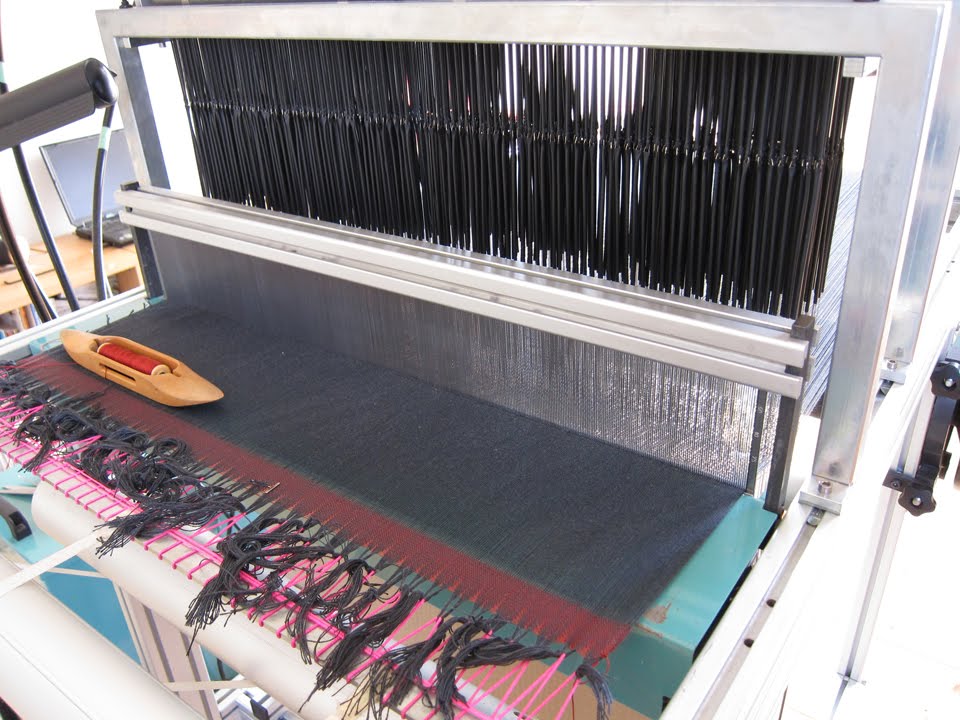
I have always been weaving on my TC-1 (Thread Controller 1 Loom from Digital Weaving Norway) loom with four modules set up one behind the other, giving me a warp density (sett) of 60 ends per inch (epi) and a weaving width at the reed of 14.4 inches. Since the interlacement of warp and weft (weave structures) brings the warp in, most of my final work has averaged 13.5 inches in width. You can see the loom above from different sides. Note that the cardboard box is my own invention--cat-proofing the springs and heddles. I had it in my head that I would do a large weaving for my upcoming show (two-person exhibition at the Chandler Gallery) if I had the time, and, if so, I would reconfigure the loom to weave full-width. This would mean I would have a width of 28.8 inches at the reed, but my sett would decrease to 30 ends per inch.

When I finished my sky weavings--East and West--which I love, by the way, I started debating with myself--leave the loom alone or take a chance on reconfiguration? Everything was working so well, did I want to rock the boat? Would I have time to complete a piece? Did I have enough warp (it would have to be heavier than the 60/2 silk I was using to account for the smaller sett) for the new piece? If it was possible to worry about it, I did. But I always came back to the conviction that this was the time to change the loom and weave at a larger width. Call it fate.

My in-house saint, Mark Goodwin, reconfiguring the TC-1

Of course, my reconfiguring the TC-1 loom translates to Mark reconfiguring the TC-1 loom. You'd think it was enough that he has made all the beautiful frames for mounting my new work, but there is always something else I can think of to ask him to do. (Do you know that expression, honey-do?) We were greatly aided by a video clip of the process that Vibeke Vestby, the inventor of the TC-1, sent to us. We (I did help) had to remove the modules, put two of them together, replace them on the loom, modify the bottom slides that hold the springs, and basically we were done. It was amazingly easy and I could move on to my next fear--rethreading the loom.

Because the modules were moved, I had to completely rethread the loom. First we had to take a trip to Massachusetts to buy new yarn (I am using 20/2 silk from Webs) (now I can worry about my credit card bill), then I wound an 18 yard warp (my longest ever) and I put it on the back beam. In the past I used a quarter-inch raddle--but that left my hands when I sold my AVL dobby loom--so I used a one-inch raddle and knew the whole time I was doing it that it wasn't right. My back beam has flanges which need to be placed at exactly the width of the warp, but I had mine wider. Don't ask me why I didn't stop and get it right--I just didn't. Then I threaded the loom. There are 880 hooks on my loom, therefore 880 threads, and after a while I got a rhythm going--count out 10 heddles from the bottom spring bar, count out 10 threads, thread the heddles. Tie them off to the right. Untie ten threads from the group tied off to the left. Start again. If you read this blog regularly you already know that counting and numbers are a big part of my life, and repeating actions are basically the life of a weaver.

The threading went smoothly too--another worry hits the dust. Threading the reed was really simple--I just made a weave file that lifted two ends at a time and ran through that file putting the lifted ends into the dents of the reed. Then I pulled the whole 18 yards forward through the reed, called for Mark's help, measured and repositioned the flanges correctly, then slowly and very carefully wound back the warp under even tension. It looks great now.

TC-1 reconfigured to 30 epi, width at reed 28.8"

Note that the cat-protector had to be modified since the box was not wide enough to fit around the reconfigured springs. I think the corrugated cardboard looks much nicer.

Recently I got a copy of Weaving for Beginners by Peggy Osterkamp. I have been reading it at night, always receptive to find a new way to do something, and Peggy has plenty of smart ideas in this book. I usually lash on my warps to tension them at the front of the loom, and she suggests using a smooth slippery yarn, like a chalk and mason line nylon. A cry to Mark and immediately I had this hot pink nylon in my hands. It has replaced the cotton cord that I used to use. I am not sure it made a difference, but like the corrugated cardboard, it looks nicer.

Note the new pink cord tensioning the warp

The weaving I wove while I was debating the reconfiguration of the loom is called His Wife. I think of it as a self-portrait. It is probably the last 13.5" width weaving I will make for a long time. Now on to that big weaving.

His Wife by Bhakti Ziek, 2010

Tuesday, September 28, 2010

Re-Entry: Fall

Night Sky by Bhakti Ziek, 2010

It has been a wonderful summer of friends, weaving, and balance. I am highly focused on work in my studio, preparing for an upcoming show in January 2011 here in Randolph, VT (hope you can make the opening, January 8th at 1pm at Chandler Art Gallery, Randolph, VT), so my blogging is going to continue to be brief, but I will try to keep you posted on the work.

Night Sky is 13.5"h x 44"w, silk warp with tencel and gold gimp wefts, woven on my TC-1 loom in a lampas construction. If you are at the TSA Symposium this week, this weaving and another one of mine are included in the exhibition Binary Fiction: Digital Weaving 2010, curated by Janice Lessman-Moss. It is on view at The Eisentrager-Howard Gallery from October 4 - October 29, 2010.

In another part of the country, Rhode Island, I will be giving a talk on my work this Friday, October 1st. It is for the Weavers Guild of Rhode Island, and will be at 11am at Slater Mill in Pawticket. It is exciting to update my powerpoint presentation, putting in the work I have been doing. Just two days ago I finished a warp, and am tying on a new red silk one now. I will try and post the new work, one at a time, for you to see.

Friday, April 23, 2010

Help Support Osloom

The deadline for the Osloom kickstarter project is "looming" (sorry, can't help myself) and I am writing this post in hope of drumming up contributions. I know Margarita Benitez from a workshop I taught a number of years ago, and have been in contact ever since. She is a bright, energetic artist, a giving teacher, and an innovator. In her Kickstarter project, she is asking for $10,000 to create a computerized jacquard loom, which will be open-source--meaning anyone else can use her data to create their own loom.

If 100 people donated $100 dollars, she would make her goal. If 200 people donated $50, she would make her goal. Or if 400 people donated $25 each, she would make her goal.

As co-author of The Woven Pixel: Designing for Jacquard and Dobby Looms Using Photoshop® (written with Alice Schlein), I know something about contemporary digital weaving and designing. As an owner of a used TC-1 loom (the Thread Controller was invented by Vibeke Vestby and is sold through Digital Weaving Norway) I am fortunate to be able to weave the images I design in my own studio. Having travelled frequently to use other looms, before I owned my own loom, I know that there are opportunities out there, but travel and classes and materials can add up quickly.

As a teacher who frequently does workshops on digital weaving, I have run into many many many weavers who moan about the high cost of the available looms. So where are you all right now when there is an opportunity to support a new venture that could yield a solution to your desires? Whether Margarita and her team of experts succeeds or not, isn't a $25 or $50 or $100 donation worthwhile in terms of hope and moving towards a new loom?

I know there have been some negative remarks written about this project--and I believe these writers meant it as concrete criticism, nothing personal or mean-spirited--and I feel Margarita has responded in an even-handed manner. Please go to the Osloom sight, and read the debate, and decide for yourself.

Kickstarter is an all or nothing situation--if the goal for $10,000 is not met, then the pledges already made fade away. I am quite sure that Margarita will continue with this project, whether she gets funding this way or not, but wouldn't it be wonderful if the weaving community, which numbers thousands around the world, would come together and make her dream our dream.

Friday, February 26, 2010

Creative Business Ideas

Snow Snow Snow

It seems like everyone else got snow this winter except us. We were seeing the ground in most places but Tuesday winter announced, in a very loud voice, "I am still here." Majestic and beautiful. Be sure to watch my video at the end of this post.

I want to talk about the Breaking into Business workshop, sponsored by the Vermont Arts Council, that I took Valentine's Day weekend. Led by Maren Brown and Dee Boyle-Clapp, the first day focused on marketing strategies and the second day on writing a business plan. As you know, I have been trying different ways to get my weavings out in the world, and I thought the comment by Neki Desu to my February 12th post, was very apt. One of the things Maren and Dee told us about were online surveys, like the ones offered by SurveyMonkey, where you can query your clients about almost anything. I had an ahha moment when I realized, I can ask you directly, right here, to help me figure some things out. So my first question is:
What can I offer that would get you to pay me money for it?

I am not saying that I will follow all suggestions, after all, I am always teaching my students to take what I say, or anyone else says, put it in a basket, and throw it in the air, like rice being separated from chaff. If it is relevant it will stick, if not, let it blow away. However, I will definitely listen, and try to "put on" all the suggestions. If something fits, I will try it. That was what my silent auction was--an attempt. When it didn't work, I took it away. I learned something--that is not the way.

I will say that in the two weeks since the workshop, and after having such a positive experience with students in Fibers at UMass-Dartmouth, I am thinking that I should increase the number of workshops I am willing to do each year, traveling to schools to do these short, intense lecture/workshop/critiques, and separate any commercial pressure from my studio weaving. This is what I did in the past, when I taught full-time, and it allowed me to create work that was labor-intensive, personal, and creative. I never allowed the thought, "who will buy this?" to enter into the equation. I am enjoying doing functional weaving for my own use--it is a daily thrill to see my own curtains hanging in the living room; the new tablecloth fabric is woven and just waiting to be cut off the loom--but I don't want to divert my art work into this direction.

Another idea that is changing is my offer of tutorial teaching. When I first moved here, it felt fine to share my looms with students for a short time--and I had absolutely fantastic experiences with all the students that have come here. But now that I want to focus on a body of work for my show in January, I don't feel I can interrupt the work on my loom for others to do work on it. In fact, I have had to turn people away for just that reason. Perhaps I can set aside specific time each year and offer tutoring during that time? What do you think?

We all have bills to pay, daily expenses for food, heat, shelter, gas, medical, taxes, and those constant surprising miscellaneous items which never stop coming just when you think you are going to have a cushion. I already have the loom of my dreams. Honestly, my needs are modest. (But modest in the USA is like funding a village in other parts of the world.) So readers, please send me your suggestions, either comment here or send me an email, and help me find ways to keep my studio practice true to itself, and still pay my bills.

I want to mention a few other things.
I broke down and signed up for Facebook. I have two accounts. One is a business page:
Bhakti Ziek - Weaver
You can sign up there and become a "fan." Just to show me some support.
The other is a personal page:
Bhakti Ziek
You can invite me to be your "friend" and I will confirm. We all need all the friends we can get, right?

The other thing is that Kickstarter.com was mentioned in the workshop, and then I heard from Margarita Benitez about her Kickstarter project. For all those who have been interested in jacquard weaving, but feel left out because of the expense of the looms, this project is just for you. Please go to her site and pledge money. She has 64 days left to raise her $10,000 goal. If she raises less than that, she gets nothing; if she raises more, she gets it all. An open source loom is a win for all of us, not just her. Please read more and get the word out to other interested people.

Finally, here is my latest video. I posted one on my Facebook page and nobody commented. Maybe because it had a red background. Try this one--blue.

Randolph Snow - Blue by Bhakti Ziek

Friday, February 12, 2010

Damask Blocks

Weaving block damask tablecloth

My tablecloth fabric is coming along nicely, as you can see above. I love the image that contrasts the simple block pattern on the loom with the Uzbekistan ikat on the pillow I am sitting on while weaving. Isn't cloth amazing--the most inspiring visual media in the world and it can be functional too! I am using Borgs Bomullin (50% cotton and 50% flax) for both warp and weft--the warp is natural and the weft is bleached. It never fails to amaze me that a weaving builds, line by line, from bottom to top, and that all these individual elements become a strong, and sometimes beautiful, plane.

Personal shrine with Poppies

You may have noticed that I removed my silent auction weaving. It was a disappointment--not one bid. I am left wondering if my weavings are truly awful. Since my ego doesn't like that thought, I have decided that people like my ideas and writing (I do have almost 9000 hits on this blog), that I am respected as a teacher, and well, yes, my work is appreciated because I am invited into lots of exhibits. Apparently my blog is reaching this audience (which I appreciate, believe me, I love seeing the number of readers increase), but you must be different than the collectors' group. I am going to take a workshop this weekend, sponsored by The Vermont Council of the Arts, called Breaking into Business. Hopefully I will learn how to reach the collectors, as well as you, so I can continue to go grocery shopping and do my weaving. In the meantime, since I liked having an image of my work in the top right hand corner of the blog, I have decided to post a monthly detail from one of my weavings. Poppies, which was a generic version of the birthday weaving I made for Liz Billings, says "Poppies gently swaying, whispering happy birthday 2U." Right now it is hanging in our kitchen (personal shrine area) reminding us that spring is just around the corner.

Tuesday, November 24, 2009

Invitation to an Exhibition

Sled Ride in Vermont, collage by Varujan Boghosian
Invitation to BigTown Gallery exhibition
Modern Treasures for the Holidays

Inside of the exhibition invitation
Big Town Gallery
99 North Main
Rochester, VT 05767
802-767-9670

The opening of Modern Treasures for the Holidays is opening this Saturday, November 28th at 4 p.m. at BigTown Gallery. If you click on the image above, the image should open in a large file, allowing you to read the names of the participants--but just in case it doesn't work, here are the featured artists: Varujan Boghasian, Lizi Boyd, Leslie Fry, Pat dipaula Klein, Abby Rieser, Charles Spurrier, Charles Shackleton, Miranda Thomas, Holly Walker, Bhakti Ziek.

Again, I am not sure if the writing on the left page of the invitation will show up in the larger image or not, but it describes the Wish Wall that is going to part of the Holiday Exhibition. Anyone can put as many wishes as they want into the wall. It is going to be a sea of color and I am sure it is going to emanate good energy. I like having more than one wish possible--then I can be selfish with some and generous with others. Of course, when one wishes something like "peace for all" or "health and prosperity for everyone" then I guess it covers oneself as well as others.

If you read this blog regularly, you know Holly Walker and I are friends. She just received great news--her work is on the cover of a new book, Masters: Earthenware by Ray Hemachandra, editor with Matthias Ostermann, curator. Pat dipaula Klein is also a friend of mine--we both were teachers at Philadelphia College of Textiles & Science (PCTS) at the same time--she in print design, me in weave. She has lovely embroideries in the exhibit.

I have a range of work in the show, some handpicked lampas weavings where I dyed the warp with natural dyes using ikat resist techniques. Also some handwoven jacquards as well as digitally woven jacquards. Birds 2, below, is one of the pieces that will be at the gallery. The background cloth, woven on a fully electronic jacquard loom at PCTS is based on a historical Italian damask from the 14th century (if my memory is right--not that I was alive then, remembering from history of textiles class). The top cloth, woven with fine, almost-invisible-as-a-single-strand silk, I handwove on a 19th century jacquard loom at Fondazione della Seta Lisio, in Florence, Italy.

I love that Birds 2 encompassed old and new modes of jacquard weaving in its making, and that the historical image is done on the new equipment, while the contemporary image (my drawing from birds in a plaza) was done with the historical equipment. The material is also flipped--silk in a form that is hardly used today for the top panel and polyester and cotton for the background. I am always talking about a continuum in weaving that goes from the first weaver to the present weaver (me, you, us), a continuum of ideas, of processes, of kinetic knowledge that helps shape an awareness of the world. Weaving is a process of unity--of bringing individual elements into a whole--chaos to order. I am sure there are weavers in this continuum who would fall in every one of the categories listed in my last blog, we are diverse as well as similar, but it wouldn't surprise me if themes like structure, systems, stories, and identity cropped up again and again.

Birds 2 by Bhakti Ziek
can be seen at BigTown Gallery holiday exhibition

By the way, I am starting to read a manual on Dreamweaver, in preparation of making my own website, one for my husband, and helping two friends create their own. Reading this (it definitely is not easy reading) reminds me how some readers must feel reading The Woven Pixel, by Alice Schlein and myself. Understanding technology is learning a foreign language. I just want to open the application and get on with it--as our readers probably want to do with jacquard or dobby design--but getting an overview is important and since I am basically ignorant about web design, I have decided to take the time to read through once, acknowledging that much of it is going over my head, not in my head. When I finish, I will start again with the book open and do their exercises, as well as start my web site. Again, impatient, I want this to happen tomorrow, but I already see that assembling the parts is going to take time and if I want to put a realistic goal on my page, I will aim for a spring debut. Just my long-winded way of saying to those of you who have The Woven Pixel, or those of you who are planning on getting it (a good holiday gift), it is an instructive book that will help you become proficient, but it still is a step by step process. Take the time to read it from the start, and to follow along with the instructions, and soon you will be master of the information.