Showing posts with label Mark Goodwin. Show all posts

Wednesday, July 1, 2015

July Already!

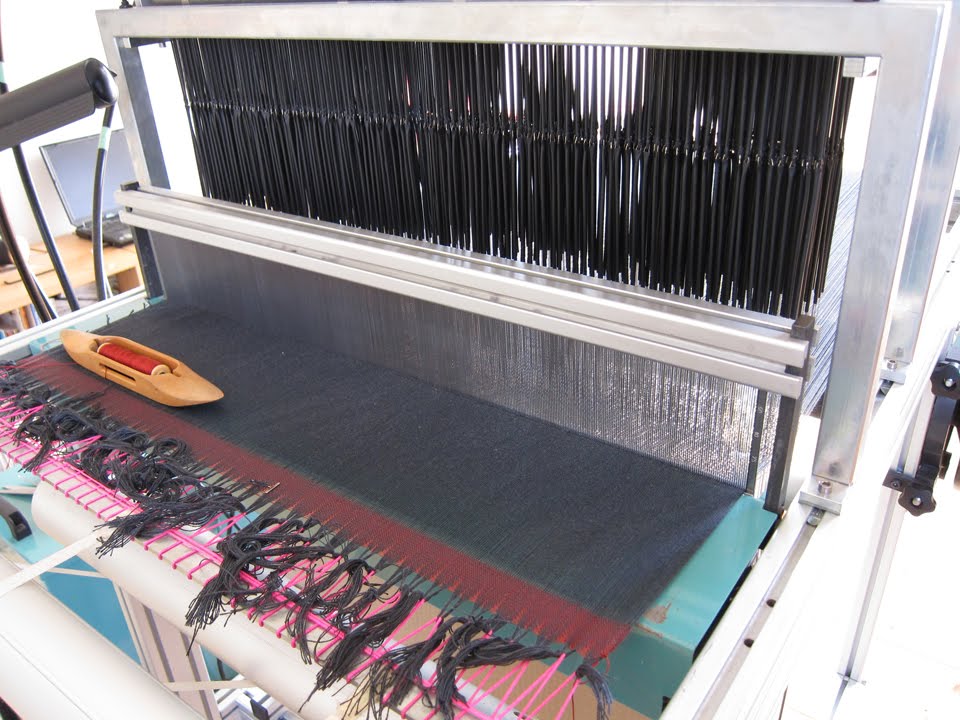
Bhakti Ziek preparing her Mirrix Loom
It's July already and I never got to post in June. So much for my intentions to be a regular blogger. But here I am today, preparing my Mirrix loom so I can take it to Penland with me. I leave on Sunday and have a full class of beginning weavers. Some people have expressed "sympathy" to me about teaching beginners but it is my choice. I could have proposed anything for my workshop but I want to work with new weavers. I hope to entice them to begin a journey that goes on for years.

Two tencel scarves woven by Bhakti Ziek in June 2015
I plan to start my students with 8/2 tencel and weave scarves (or table runners or just plain cloth). If someone wants to work with other yarn, that is fine--I see my role as explaining and demystifying the process of weaving on a floor loom. I wove the scarves above because I didn't know whether I prefered 24 epi or 30 epi for this yarn. Guess what--after washing and ironing I still don't know. At least the students will have physical examples to touch to help them make their choices.

Detail on top shows the two sides of scarf woven as a 1/3 twill (so reverse is a 3/1 twill)--there are changes of structure woven in stripes but always 1/3 tie-up; bottom shows the other scarf, woven as a 2/2 twill, with the weft color sequence forming a plaid (both sides of this scarf are the same); scarves woven by Bhakti Ziek, June 2015
Alpaca and silk scarf woven as a deflected double weave, by Bhakti Ziek
Here is an image of the second deflected double weave scarf I made using alpaca from Wild Hair Alpacas and silk from Henry's Attic. I was really pleased with the results and look forward to more exploration of this structure with those yarns. I sent this scarf and the other alpaca scarves out to Colorado to the store at Wild Hair Alpacas. They are having several open houses this summer and fall, so check their website for more information.

Third tapestry sampler woven by Bhakti Ziek for the online course taught by Rebecca Mezoff
I am continuing with Rebecca Mezoff's tapestry class online. This is my third sampler, which concludes the end of part two. There is another part to go--which makes me happy. I still have to finish the three studies--sew in the ends, that kind of thing. The instructions are in part three, along with learning to work with cartoons and weave shapes. I am going to do another study though of what we covered in parts one and two before proceeding with the rest. That's what I am doing in the first image--preparing the warp for another study that will probably be blocks and stripes, hatching and interlocks, demi-duites and floating bars. Rebecca has a video showing work by many artists using these processes and I am in awe of their skillfulness and creativity. Most of them are quite intricate narratives, which of course is a great tapestry tradition, but I am feeling very minimal these days and I think squares and color are going to be enough for me for now.

Demi-duites in top form are very neat on the face of the tapestry, but a mess on the back; detail of tapestry weaving by Bhakti Ziek, woven as a study in the online course taught by Rebecca Mezoff
Mark Goodwin preparing walls of Chandler Gallery, to hang Sisyphus, a seven panel weaving by Bhakti Ziek
There is another opportunity to see my seven panel weaving Sisyphus! The current show at Chandler Gallery in Randolph, curated by Rebbie Carleton, is called Creative Cosmos. It is up through September 7th. There will be a reception for the artists on August 8 from 6-8:30 pm and earlier that day, at 4:30 pm, the artists will talk about their work. My wonderful husband, Mark Goodwin, once again helped me hang my work. Okay--he did all the work and I watched.

Three panels from the seven panel weaving, Sisyphus, by Bhakti Ziek, 2015. Each panel is 28"w x 88.5"h, silk, cotton, metallic yarns, handwoven satin damask, hand woven on TC1 looms
Mark Goodwin's studio, June 2015
I will get home from Penland the night before Mark has an opening of new work at BigTown Gallery on July 18th. Perfect timing. His work and paintings by James McGarrell will be up from July 15-September 6, 2015. Meanwhile if you haven't seen the Viva Cuba! exhibit that is showing there now, it is not to be missed. 

Wednesday, September 5, 2012

Repetitive Motions

This has been the summer of repetitive motions. You might leap to the conclusion that I am talking about weaving--the rhythmic throwing of the shuttle from one selvedge to the other, feet alternately depressing pedals--but I am talking about scraping paint off the house, painting on primer, painting the first coat of color, then painting the second coat. Of action that seems like it is going nowhere but suddenly a new view pops into focus. The last week or so it seems the house really is looking different.

Summer house work in Vermont
That's Mark's woodpile at the bottom, referencing the Green Mountains of Vermont. Stacking the wood started the summer work. After some attempts to avoid the house painting (successfully ignored for several years) we just bit the bullet and started scraping. What you can't see are all the clapboards Mark had to replace, or the rotting window frames he fixed, or that the steps are new and include a poured cement step. In other words, what he has done looks so good that you don't notice how much he has done. It's like that with art too.

Garlic from Tunbridge Hill Farm, Tunbridge, VT
It's like that with the garlic we have been peeling for the last month and will continue through October. I never realized that the bulbs I have purchased in the past, white and clean, had to be carefully peeled to remove the dirt in which they grew and the outer stained layers so that the customer could purchase the illusion of pristine bulbs. So, in exchange for our CSA share, we have put peeling garlic into our summer routine. Scrape, scrape, peel, peel. Read.

I am reading Simon Schama's Landscape and Memory. Recommended by a friend, it made my eyes sparkle from the very first sentence. I am trying to understand the myth of place, and this author, who addresses it, along with fascinating, meandering discussions that others might ignore but that he, happily, feels it necessary to explore in order to complete the idea he is addressing. Big old Victorian houses that need painting every year and garlic bulbs and local food are part of the landscape of Vermont. What parts of the illusion do I cherish and want to keep in my life? What parts seem like the DisneyWorld Pastoral Ride to me? It seems many of the places I have lived have strong identities ("Santa Fe" evokes a rich tapestry of images that are quite distinct from the equally rich tapestry of images evoked by the word "Vermont"). When I look at a map of the USA I realize that ideas of place keep me from considering many states as home. In fact, right now, I think the lack of a myth about another place is keeping us stationary.

Elin Noble and friends at her exhibition at Colo Colo
Stationary, not immobile. Just had a wonderful day with a friend driving down and back to New Bedford to see Elin Noble's inspiring exhibition at Colo Colo Gallery. These small marbled pictures are worlds within worlds, swirling energies of macro and microcosm, everything contained in nuances of black and white.

Garden Spirits by Lasse Antonsen at Slocum's River Reserve
We also got to visit the Slocum's River Reserve to see Lasse Antonsen's installation of Garden Spirits. Eeire forms, part tree, part insect, part alien figure, the installation is a wonderful start of a career change where Lasse has exchanged his curator's hat for that of an artist's. I am sure this multi-faceted creator is actually going to be many-headed continuing as writer, teacher, artist, explorer.

Amaral's in New Bedford, MA
What we didn't get to do was shop at Amaral's or walk the beach at Horseneck Beach--both priorities on the trip but proof that things are not in our control. However, I was able to get some Portuguese food items at Marketbasket--needed because the current Dowdy Corners Cookbook Club selection is David Leite's The New Portuguese Table. I made his green soup last night and it was delicious--perfect for these early fall days that seem colder than they are because they are in such close proximity to the glorious warmth of summer. You know I am not a cold weather aficianado, but I admit that I am ready to put away the scraper and pick up a shuttle, exchanging one repetitive motion for another.

Friday, September 16, 2011

New York, New York

Beginning and Ending of Trip
Just back from a week in New York City. We went there primarily for art but of course I took advantage of the fact that macarons are everywhere and did some scientific research on taste. Prices ranged from $1.95 to $3.00 per cookie, and texture and flavors varied considerably. They all looked pretty but I would not purchase any of them a second time. On the other hand, the cappuccino pictured above at the Espresso Bar on 6th Avenue near 57th Street was definitely something to repeat.


New York Moments
The weather was beautiful, the moon sublime, and the city familiar and strange at the same time. We noticed so many wonderful new buildings, and visited some classics, like the Chrysler Building above right. We made pilgrimages to some art supply stores, resisting temptation until we got to Kremer Pigments, middle left above. It wasn't just the seductive shelves of color, but the kindness of the two people working there that convinced us to make purchases. I found the current bible of natural dyes there (Dominique Cardon's Natural Dyes) and snapped it up (okay, Amazon would have been less but this place had character).

We went to museums and galleries (I will post about some later) and were amazed at the crowds viewing art. I remember turning to Mark and asking, "Do all these people really love art?" He reminded me of the high entry fees for entering the museums, so clearly they must have some commitment to be there. In the past I could always find an area of the MET that was quiet and off the beaten path--the crowds staying in the current blockbuster, the art lovers wandering into the corners--but this trip every room of the MET (and we probably entered most of them) was crowded.


The city seems much cleaner and upscale in all the neighborhoods than before. We went north, south, east and west and it was very rare to see someone asking for money. The one street dwelling that I saw had an Ikea chair like one I used to own. Of course I am older than when I last visited New York (it has been almost 11 years), but the population of the city also seemed much younger and wealthier than I remembered. I was a resident of the city at 21, so I know about "owning" the city, about posturing and attitude, but we did it on a shoestring. Even today I feel hailing a taxi is an outrageous way to spend money. The 7 Day Metro Cards that we purchased made the buses and subway extremely easy to use.

This trip was really a "grant" from two wonderful friends who went to Portugal and invited us to stay in their apartment. We missed seeing them (luckily had dinner with one of them the last night) but we were able to spend time with some other friends.
David Reisman and Mark (above bottom right) studied art together at University of Kansas in the late '70s--and they are both still making art. Going to Chelsea galleries with him was lots of fun. 


Egyptian Order at the MET
When I got home I noticed that Mary Early had posted an interesting article on Facebook about organizing things and it reminded me of these images I took at the MET in the Egyptian area. Aren't the stacks of linen wonderful?

Just a note to say that the exhibition I am in with Pat Adams, at BigTown Gallery, has been extended until October 23, 2011. Things are getting back to normal in Rochester, Vermont with many of the roads accessible now, but that town has been badly hurt and if anyone wants to contribute to helping this town that truly has a heart, you can make a donation. Click HERE for a link. New York Times mentions Anni Mackay, owner of BigTown Gallery, as one of the town heroes.

Monday, July 4, 2011

Erratic Blogger

Mark's Woodpile Summer 2011

Maybe you noticed I added something to my blog heading--"erratic blogger." I thought about sporadic blogger but decided erratic was a better description of me. This way I can blog daily if I want to, or monthly, or as it seems right now, not even monthly. I think about it...but I don't seem to get there. Mark's summer woodpile shows the seasons here. Another round has started and we are drying out the wood we will need over the winter. Last year we actually had enough wood in the basement to skip a new pile, but this year's stack seems to be generating lots of neighborhood comments. All positive--it is an impressive form.

Jessica Smith and Bhakti Ziek

This week seemed to bring Lawrence, Kansas energy into my life. I realized that I am living my Lawrence, Kansas Victorian house dream in Randolph, Vermont. A good example of not getting what you want when you want it, but if you persevere you might get it in another form down the road. I love this house, and the way I am working in it -- seriously creating new work absolutely reminds me of my days as an undergraduate in Lawrence. Something about working in such a diligent way brings so much hope and insight into my life. Jessica Smith, who teaches at Savannah College of Art and Design was one of my graduate students when I returned to Lawrence in 2000 as a teacher at the University of Kansas. She came up here to hike and I was lucky to have visits on both ends of her camping trip. I loved having her be the teacher now, and me the non-teacher. Her work is amazing and I am going to show it at the workshops I am teaching next week for the New England Weavers Seminars (NEWS). So I guess sometimes I am still a teacher, but not too often.

Mark Goodwin, Bhakti Ziek and Gail Moran

Just after Jess left to continue her travels, our friend Gail Moran showed up. We know Gail from Lawrence, Kansas also--but from those undergraduate days in the late 1970s. We remember going to a waterfall with her in 1983 in New Mexico, when we were travelling across country after 16 months in Asia, and she was living in Albuquerque. She doesn't remember that but remembers visiting us in Philadelphia when her eldest son was a baby and her 18 year old son wasn't even born. We remembered that visit but not the Philadelphia part. It was so great to catch up, and also go down memory lane. She said I was passionate about weaving back then, and I still am. In fact, I just finished a weaving today that I am really excited about. I am working towards an August two-person show that will be at BigTown Gallery. I will post about that later, sometime, sooner than later.

Randolph's Fourth of July Parade

Like the woodpile, the Fourth of July Parade is another marker of time. The parade comes right past our house so we always have front row seats. This year seemed especially nice--and though the oxen were missing, there were a few small horses, chickens, and sheep, as well as tractors, old cars, and lots of fire engines. I told Gail she was going to experience quintessential America in this parade, and I think she wasn't disappointed.

Did I ever announce that I finished a website for Mark? You can click HERE or go to this website if you want to see his work.

Later this summer, or early fall, after the workshops at NEWS, after Michele Wipplinger's Color Institute Workshop which I am taking at Long Ridge Farm in a few weeks, after tutorial teaching, and after my exhibition at BigTown, then I plan to do a new website for myself. Maybe I will blog in there too--but now that I am an erratic blogger I won't feel guilty that my posting is unpredictable.

Sunday, February 6, 2011

Catching Up

Friends Visiting Exhibition

It has been wonderful to have friends from out of town visit and give me feedback on my continuum series. Since the opening (see previous post), Cyndy Barbone (top), Myra Serrins (second from top), Deborah Carlson (third from top), and Marcie Miller-Gross (shown here with Elizabeth Billings in bottom image) came to Randolph. I couldn't photograph Marcie in the show, since I was taking a workshop when she and Liz went to see it, but the phone call afterwards was sweet to my ears. All these friends are weavers (though Marcie's work has moved into another mysterious and intriguing place) and were able to give me good critical feedback to consider for future work. The show is still up until February 20th, and two more weekends will bring two more friends, so life is sweet. I did a talk on my work last weekend and Myra snapped an image of me in front of Chandler.

Bhakti standing in front of Chandler Center for the Arts with her name in lights

Canvas woven for Mark Goodwin

I haven't been focused enough to start new work on the TC-1, but have been weaving. I finished yardage of plain weave cotton/linen canvas for Mark to use in his work. The focus in our house has shifted from my preparation for an exhibition to his preparing for a one-person show at BigTown Gallery that will open on May 4th.

Sara Goodman's Dye Workshop

I also took a dye workshop with Sara Goodman in her studio in Lyme, NH. Just five of us, snow outside, warm inside, painting warps with Earthues Natural Dye Extracts. I used to think I invented painted warps (back in the late 1970s), which just shows how ignorant I was about the history of textiles, and I have written articles on the topic and taught many workshops on painted warps. I have even used the dye extracts on my own to paint a warp or two, but I didn't have a handle on the colors, the way I did with procion MX dyes. So it was wonderful for me to learn something new about something familiar, and to jump start a process that I hope to introduce into my next series of jacquard weavings. Sara also had an indigo pot going (notice how she uses all the proper gear for working with those chemicals), and at the end I was able to dip the end of my warp into both indigo and cochineal pots, ending the warp with red, purple and blue. I still have to steam it and wash it, but you can see my colorful warp wrapped in plastic above. Myra Serrins was in the class too (shown above left with Sara), and Carol and Amy (bottom left) and Toby (not shown) were also there. Sara will be teaching a dye workshop at New England Weavers Seminar 2011 (NEWS) so if you are interested, sign up. I will also be teaching there--photoshop for textile design.

Weaving crackle diamonds

Now I am trying to weave off the warp on one of my small macomber looms. I used a threading from the 8-shaft book by Carol Strickler, and am weaving off all the bits of color that are filling my bobbins. Maybe I will have some new dishtowels in the end. For sure I will have a box of empty bobbins so I can start fresh with my next work.

Lots of links in this post. I intended to try and post weekly in 2011, but have not been able to do so. I appreciate that people are still reading my blog and sending me personal emails with comments. Hope you are having as beautiful and snowy a winter as we are having in Vermont. I really loved the mental image of this country blanketed in snow from coast to coast, though I realize many places were not equipped to handle it the way they do here. Stay warm.

Thursday, December 9, 2010

Reconfiguring the TC-1

TC-1 with 4 modules, 60 epi, 14.4" in reed

I have always been weaving on my TC-1 (Thread Controller 1 Loom from Digital Weaving Norway) loom with four modules set up one behind the other, giving me a warp density (sett) of 60 ends per inch (epi) and a weaving width at the reed of 14.4 inches. Since the interlacement of warp and weft (weave structures) brings the warp in, most of my final work has averaged 13.5 inches in width. You can see the loom above from different sides. Note that the cardboard box is my own invention--cat-proofing the springs and heddles. I had it in my head that I would do a large weaving for my upcoming show (two-person exhibition at the Chandler Gallery) if I had the time, and, if so, I would reconfigure the loom to weave full-width. This would mean I would have a width of 28.8 inches at the reed, but my sett would decrease to 30 ends per inch.

When I finished my sky weavings--East and West--which I love, by the way, I started debating with myself--leave the loom alone or take a chance on reconfiguration? Everything was working so well, did I want to rock the boat? Would I have time to complete a piece? Did I have enough warp (it would have to be heavier than the 60/2 silk I was using to account for the smaller sett) for the new piece? If it was possible to worry about it, I did. But I always came back to the conviction that this was the time to change the loom and weave at a larger width. Call it fate.

My in-house saint, Mark Goodwin, reconfiguring the TC-1

Of course, my reconfiguring the TC-1 loom translates to Mark reconfiguring the TC-1 loom. You'd think it was enough that he has made all the beautiful frames for mounting my new work, but there is always something else I can think of to ask him to do. (Do you know that expression, honey-do?) We were greatly aided by a video clip of the process that Vibeke Vestby, the inventor of the TC-1, sent to us. We (I did help) had to remove the modules, put two of them together, replace them on the loom, modify the bottom slides that hold the springs, and basically we were done. It was amazingly easy and I could move on to my next fear--rethreading the loom.

Because the modules were moved, I had to completely rethread the loom. First we had to take a trip to Massachusetts to buy new yarn (I am using 20/2 silk from Webs) (now I can worry about my credit card bill), then I wound an 18 yard warp (my longest ever) and I put it on the back beam. In the past I used a quarter-inch raddle--but that left my hands when I sold my AVL dobby loom--so I used a one-inch raddle and knew the whole time I was doing it that it wasn't right. My back beam has flanges which need to be placed at exactly the width of the warp, but I had mine wider. Don't ask me why I didn't stop and get it right--I just didn't. Then I threaded the loom. There are 880 hooks on my loom, therefore 880 threads, and after a while I got a rhythm going--count out 10 heddles from the bottom spring bar, count out 10 threads, thread the heddles. Tie them off to the right. Untie ten threads from the group tied off to the left. Start again. If you read this blog regularly you already know that counting and numbers are a big part of my life, and repeating actions are basically the life of a weaver.

The threading went smoothly too--another worry hits the dust. Threading the reed was really simple--I just made a weave file that lifted two ends at a time and ran through that file putting the lifted ends into the dents of the reed. Then I pulled the whole 18 yards forward through the reed, called for Mark's help, measured and repositioned the flanges correctly, then slowly and very carefully wound back the warp under even tension. It looks great now.

TC-1 reconfigured to 30 epi, width at reed 28.8"

Note that the cat-protector had to be modified since the box was not wide enough to fit around the reconfigured springs. I think the corrugated cardboard looks much nicer.

Recently I got a copy of Weaving for Beginners by Peggy Osterkamp. I have been reading it at night, always receptive to find a new way to do something, and Peggy has plenty of smart ideas in this book. I usually lash on my warps to tension them at the front of the loom, and she suggests using a smooth slippery yarn, like a chalk and mason line nylon. A cry to Mark and immediately I had this hot pink nylon in my hands. It has replaced the cotton cord that I used to use. I am not sure it made a difference, but like the corrugated cardboard, it looks nicer.

Note the new pink cord tensioning the warp

The weaving I wove while I was debating the reconfiguration of the loom is called His Wife. I think of it as a self-portrait. It is probably the last 13.5" width weaving I will make for a long time. Now on to that big weaving.

His Wife by Bhakti Ziek, 2010

Tuesday, October 5, 2010

Bear Island and Code

Bear Island by Bhakti Ziek

I wove Bear Island (above) after a week on that incredible island. It is 29.5"w x 13.5" high. Think sea rocks, letters from a gravestone and an "energy" overlay.

Code by Bhakti Ziek

This is Code finished. Images of it in process were in earlier posts. It is 40.5"w x 13.25"h. If you remember the images on the loom, it has changed color. I dyed it with inexpensive black tea. I noticed the grass outside died where I poured the tea out, so image what it is doing to my insides.
Bear Island and Code with Sculpture by Mark Goodwin

An interior shot of the office room, which is looking good with work by me and Mark, and a felt rug from Turkey on the floor. Fortunately the rug is old and frayed, because our cats are making it more frayed by the minute.

Chris Allen-Wickler sewing weaving by Bhakti Ziek

Lucky me, not only do I get a visit with Chris (above) but she is helping me finish some of the weavings. When I was weaving my thesis work at Cranbrook, she and Marcie Miller-Gross saved my life by hemming the work as it came off the loom--and we were working up to the last minute. Fun to revisit those days so many years later--on one hand it seems like no time has passed, on the other when we talk about her daughter at University of Michigan, we realize it has been many years. Chris is here between shows--she will exhibiting her fabulous garments (Allen-Wickler Artwear) at the Letchworth Craft Show near Mt. Morris, NY this weekend.

Sunday, April 11, 2010

Weaving Lesson: Threading a Loom

McMorran Balance, Weighing Yarn, Finding Sett

When I wrote on Facebook that winding warps was one of my favorite activities, my friend Ann said I was "wacky." But i do love the set up of a loom, winding the warp and dressing the loom, something I miss when I add a new warp to the TC-1 loom by tying knots that connect the old warp to the new one. For all those of you who think weaving and setting up a loom is a boring process, I say, it is fraught with tension--a mine field where every step has a possible mishap lurking. So I photographed my process the other day to share with those of you who have never woven, and might be interested in the process. Before you actually get to throw the shuttle and actively make cloth, there are dozens of steps that proceed, and lots of lovely tools to help in the process.

One warp I wanted to make was from a spool of linen thread, which had no data on it--so I took out my McMorran Balance to find out the approximate yards per pound of this yarn (1300). Then I weighed the spool (15 ounces); and then I did a warp wrapping to find out how many ends per inch would work for a balanced plain weave (10 epi) (the warp sett). Calculator, pen and paper (not photographed) got me the calculations that I could safely wind a 24 inch width at 10 epi of almost 3 yards and have enough yarn left for the weft. (We will see.)

Overall Picture of Threading Loom; Counting 40 Warp Ends

With the warp wound, I can go to the loom. The following pictures are of a different warp than discussed above--this one is 40 inches wide, Borgs Bomullin (50% flax and 50% cotton). I wound on an 11 yard warp (with the help of my husband), and the plan is to thread 20 ends per inch--800 threads. What isn't pictured is the hours spent counting the heddles on each shaft, moving them over so they are in the proper place on each shaft (these shafts are divided into three areas) and adding heddles on each of the eight shafts since none of them had enough heddles. There was math involved here too--800 divided by 8 = 100 heddles per shaft; then divided appropriately for the three sections which are not identical in width. Above you see the general set up--note the important coffee cup which seems to be making an appearance in every step of the process. On the right you see me counting off a group of 40 ends.

Counting and Moving Over Heddles; Threading Heddles

Then I count off a group of 40 heddles--5 on each shaft (40 divided by 8 = 5). I should note that I go for accuracy rather than speed and I have these processes which help show me as I am going whether I have made a mistake or not. I would much rather correct a mistake in 40 threads than find out at the end that there is a problem somewhere in the middle, or anywhere. I hold the 40 ends in my right hand, along with a threading hook, and use my left hand to move over the correct heddle and pull out the next thread from the group and hold it taunt so the hook can grab it and pull the thread through the eye of the heddle. If I have done everything right, there are now five threaded heddles per shaft and no extra threads in my hand, and no shaft with more or less than five threads.

Pulling Group of Warps in heddles and tying them in a knot

Then I pull the group tight and make an overhand knot in front of the heddles. Even though i don't go for speed (I always lost to my friend Marilyn when we worked together in her studio in Brooklyn in the mid-80s), I am always amazed how fast this process can go. It definitely takes me about a third of the time to thread a loom than to tie the knots on the TC-1.

Pulling two warp ends through dent of reed using a hook and tying groups in a knot

After all the warp ends are through heddles, I get to thread the reed. In this case I used a 10 dent reed, and put two ends per dent (bringing the sett up to 20 epi). Reeds come in different divisions, and over the years I have acquired a great variety. If I had decided on 30 epi, I could use this 10 dent reed (10 spaces per inch) and put three threads per dent, or I could use a 15 dent reed and put two threads per inch, or, if I had it, and the threads moved smoothly through the space, I could use a 30 dent reed and put one thread per dent. The cloth I am going to make is going to be a fairly open plain weave, but the cloth will shrink when washed and make the cloth firmer. It is going to be used by my husband, Mark Goodwin, for his work.

Mark and I have talked about collaboration before, or tried to talk about it--I guess I am not an easy collaborator. But he has been doing some experiments on cloth I have given him, and the results are starting to be really intriguing. You can see two of them below. So now I am going to make yardage for him so he can really explore. I don't know if the energy I am putting into the weaving is really making a difference, and I don't actually think this is a collaboration, since the creativity is all coming from his side once he has the cloth, but I do like the idea that the cloth is a catalyst for him, and I like that I have this weaving to do. It is different than the work on the TC-1, less demanding in terms of expectations on my part. Thinking about why I like dressing a loom so much, I realize it is an activity where I feel in control--I have mastery. It is one of those mind-body connections where I have done it so often that the smoothness of the process feels right--I feel right--in other words, I know what I am doing.

Drawing by Mark Goodwin on cloth woven by Bhakti Ziek

Another Mark Goodwin drawing on Bhakti Ziek cloth plus more work by Mark Goodwin

Will end with an image of the beautiful light pattern on Mark's studio wall yesterday. We both wish we could claim it as our art.

Light Pattern on Wall

Sunday, April 4, 2010

Re-Cycle

Spring Returns

Here's our first spring flowers! So the cycle starts over. I guess you could say this every day--every morning a fresh start; every evening a return to sleep. But sometimes it takes something remarkable to make you conscious of the passage of time and the recycling of events. The almost 80 degree temperature the last few days was certainly a jolt--but for me it was the jauntiness of these crocuses that really said, once again it is spring.

Weaving cycle: winding warp, tying knots

Weaving is all about cycles, repetition and movement. I am all over the house right now working on the next weaving. Winding the warp on the ground floor meant bringing skein winder, spool holder, bobbin winder, yarn, scissors, and tying thread downstairs so skeins of yarn could be converted to a new 4 yard warp. I am aware that my process is very inefficient--tying 880 ends, new to old, for just four yards is going to really get to me after a few warps--but I don't want to have the same ground on these weavings, and I don't want to paint my warps. I was talking to a friend about this, how a process that was once almost my signature has no draw for me now. I did consider it, it would enable me to wind a long warp and make each section different--but then I would be locked into the colors that I dyed now--and really, I want each piece to inform the next one. So I have opted for "slow" work--each warp short and distinct. The current one is stripes of white yarn--a silk and ramie mix, a silk and linen mix, and several variations of 100% silk. All 880 knots are now tied.

I took the knot tying as an opportunity to have a Bob Dylan festival--all Dylan all day for two days--one of my favorite events that has cycled through my life ever since I first became a fan. At one point I was sure I would meet him--it was inevitable. One of the first weavings I did was a guitar strap woven on a belt loom that an acquaintance of mine, who knew Dylan, supposedly gave him from me. That was back in 1969. I guess I hoped I would see it on his guitar at one of the concerts, or, even better, on one of his album covers. It was inevitable, right. Listening to him sing brings on such a weird combination of nostalgia and the present moment. How many classes did I cut when Blond on Blond was first released? I had never heard a sound like that album before--I just couldn't get enough of it. As soon as it reached the end, I would just get up to start it over, then lie down on the floor again, completely mesmerized. As often as I have listened to his music, I can still hear a new phrase, or get a jolt from a familiar one. So I will never get to say thank you in person, but these days I realize I don't need to meet him. I think the gratitude in my heart is enough.

Detail showing front and back of March weaving

One of the things I like about lampas is that the front and back of the cloth can be so different. Here is a detail of both sides from the March weaving that I posted last time. I used four wefts--and on the front you see distinct areas of color (plus you are seeing warp strips too) but on the back the wefts combine to give a completely different coloring. Sometimes I have combined both surfaces in one weaving, but not in this one; nor in the small weaving I squeezed out of the final bit of warp. I guess you could call this the cliff notes version of my March weaving, or Mini March. There are differences, the gold lattice is not outlined in black, the warp stripes run vertically here where they are horizontal in the large weaving. They are clearly related though: cycle and recycle.

Cliff notes version of March weaving

Both Mark and I have been busy in our studios these last few weeks. It's not like we aren't always doing something, we are, but some periods are just more productive than others. Again, a cycle. When we first met, as students at the University of Kansas, we would work late into the night, into the morning really. Around 2 or 3 a.m. one of us would go find the other (I was on the 5th floor, he was in the basement) and we would head home. Thirty years later we are still spending our finest hours alone in our studios--but this work, these hours, it is what makes our time together potent and interesting. Living with an artist means I have a partner who understands and honors the fact that making my work demands private time, lots of private time--just as I honor his work space and needs too. It is nice though, that I can tell him in person, periodically, how lucky I am to share my life with him. Personal cycles.

Drawing by Mark Goodwin