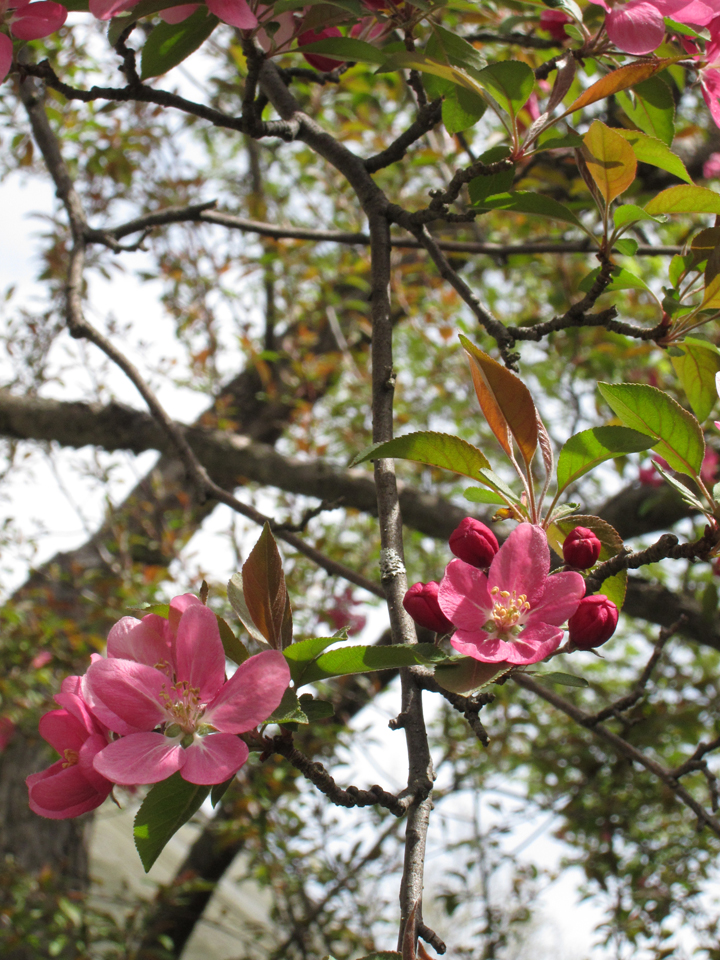
My favorite tree is in bloom.
Just when I think winter will never end, the buds start showing up and there is hope. This year the buds appeared, then there was a freeze and I panicked--maybe they wouldn't bloom. But here they are.
Their beauty so strong that they get me out of the house to look closer, and to share with you.
This bloom reminds me of the incredible painting by Van Gogh that is on display at the Philadelphia Art Museum in the exhibition Van Gogh Up Close. It closes tomorrow but moves on to the National Gallery of Canada in Ottowa, May 25 to September 3, 2012. The painting comes right at the end of the exhibition, and clearly the curators also feel the power of this painting since they put it as the first illustration in the catalog and as a two-page detail at the end. Almond Blossom, from 1890, shows a branch of the flowering tree silhouetted against a fantastic blue-green sky. When I saw it I almost burst into tears. It has nothing contrived about it. It's not cleaver, or witty, or conceptually smart--it simply conveys an absolutely present communication between the artist and the tree--so honest that anyone looking at the painting must feel the exhilaration of being alive. It is what I wish of my work, and why I appreciate the tree outside my window.
Thank you for the encouragement to continue writing this blog that came in emails and online. It makes me happy to share my thoughts with you; keeps me connected from my corner of the world. I do post in facebook fairly often, so if you aren't my friend there, please send a request. You can like my professional page (bhakti ziek weaver) or ask to be friends on my personal page (bhakti ziek). Or do both--why not?
Showing posts with label museums. Show all posts
Saturday, May 5, 2012
Friday, September 16, 2011
New York, New York
![]() |
| Beginning and Ending of Trip |
![]() |
| New York Moments |
We went to museums and galleries (I will post about some later) and were amazed at the crowds viewing art. I remember turning to Mark and asking, "Do all these people really love art?" He reminded me of the high entry fees for entering the museums, so clearly they must have some commitment to be there. In the past I could always find an area of the MET that was quiet and off the beaten path--the crowds staying in the current blockbuster, the art lovers wandering into the corners--but this trip every room of the MET (and we probably entered most of them) was crowded.
The city seems much cleaner and upscale in all the neighborhoods than before. We went north, south, east and west and it was very rare to see someone asking for money. The one street dwelling that I saw had an Ikea chair like one I used to own. Of course I am older than when I last visited New York (it has been almost 11 years), but the population of the city also seemed much younger and wealthier than I remembered. I was a resident of the city at 21, so I know about "owning" the city, about posturing and attitude, but we did it on a shoestring. Even today I feel hailing a taxi is an outrageous way to spend money. The 7 Day Metro Cards that we purchased made the buses and subway extremely easy to use.
This trip was really a "grant" from two wonderful friends who went to Portugal and invited us to stay in their apartment. We missed seeing them (luckily had dinner with one of them the last night) but we were able to spend time with some other friends. David Reisman and Mark (above bottom right) studied art together at University of Kansas in the late '70s--and they are both still making art. Going to Chelsea galleries with him was lots of fun.
![]() |
| Egyptian Order at the MET |
When I got home I noticed that Mary Early had posted an interesting article on Facebook about organizing things and it reminded me of these images I took at the MET in the Egyptian area. Aren't the stacks of linen wonderful?
Just a note to say that the exhibition I am in with Pat Adams, at BigTown Gallery, has been extended until October 23, 2011. Things are getting back to normal in Rochester, Vermont with many of the roads accessible now, but that town has been badly hurt and if anyone wants to contribute to helping this town that truly has a heart, you can make a donation. Click HERE for a link. New York Times mentions Anni Mackay, owner of BigTown Gallery, as one of the town heroes.
Labels:
art,
BigTown Gallery,
friends,
Mark Goodwin,
museums
Wednesday, April 27, 2011
Report on Road Trip -- Part III

Beautiful Washington D.C.
Washington D.C. was showing all its beauty last week, and I was thrilled to have a strong fix of urban energy. One stop was to see the work of Ford/Forlano who were exhibiting their incredible jewelry in a small show downtown. I might not wear jewelry myself, but I am always inspired by the creativity of Steve and David. We also stopped by Hemphill Fine Arts to see the current exhibition and catch up with one of the directors, Mary Early, whom I met in Vermont recently. Mary's sculptures were featured in the January/February 2011 issue of Sculpture Magazine. Next time I am in D.C. I will definitely make time to visit her studio.
I was very concerned about the potential government shut-down (not just because it proved that politicians think life is a reality TV show and the public so stupid that they can't see through their cliff-hanging-wait-to-the-last-minute shenanigans) but because I really wanted to get to the Hirshhorn Museum to see the Blinky Palermo exhibition, and of course all the Smithsonian Museums would all be closed if the government was shut down. Mark has mentioned Palermo to me for many years, and he particularly wanted me to see the work shown in the image below (which I found on the web since I wasn't allowed to photograph in the exhibition itself). When I walked into the room I thought they were paintings, but in fact they are dyed cloth impeccably sewn together so you hardly notice the seam lines. Beautiful nuanced use of color, and a very innovative way to paint back in the late '60s. Even today it would be considered innovative (in any other world except the textile world). Another contemporary artist who works with fabric but is not defining himself in terms of textiles is Sergej Jensen.

Fabric paintings by Blinky Palermo
One of the things that really delighted me about the Palermo exhibition was that they gave the work the space it needed. In one room, there were four small cubes of color attached to a corner, two on either side of the wall joint. That was it. It just thrills me to see work displayed like this. On my way home, I stopped for lunch in Philadelphia with my friends Michelle Liao, Meg Richter, and John Struble. We had a delicious beet salad in Michelle and John's loft, which is above Michelle's store, the Liao Collection. It also happens to be blocks from Chinatown. So I was impressed that I enjoyed the salad so much (so much that I made it for Mark's birthday a few days later) that I didn't kick and scream about not having dim sum with them. Maybe it was because hanging out in that loft is like going to the museum--there is nothing redundant or frivolous in the space. Every object is perfect, and they are placed so the whole is about air and light and beautiful energy. I love these three people so much that I could weep every time I think about leaving Philadelphia and our weekly dinners together. What is incredible though is that life has brought important changes to all of us, but the heart connection is still so strong and vibrant. A trip back to Philadelphia is definitely in the works.

Philadelphia Friends: Meg Richter on left, Michelle Liao in center, John Struble on right
I drove from Philadelphia to Greenwich, NY without problems--but arrived at my friends Cyndy Barbone and John Golde's home in the dark. I must have driven up and down the same stretch of road six times before I finally parked my car in someone's driveway and got out to try and find a house number. I found one four houses down from my car--and when I counted back, it turns out I had pulled into their driveway. Cyndy is an amazing weaver. She usually makes narrative panels that add up to a story about light and spirit. A visit to her studio the next morning showed some of those, as well as fabric being woven on her loom that will become a winter coat. Since Cyndy has visited us in Vermont a couple of times, I was so glad to reciprocate and see her place. It is really rather close, so I imagine we will see more of them this summer.

Cyndy Barbone with her weaving and Peanut on the left;
work in progress and sample woven and shrunk on the right
So that pretty much covers my amazing, energy-filled trip to Maryland/D.C. area. While I think about it, I want to mention a book I just finished: Seven Days in the Art World by Sarah Thornton. It is not the art world that I know. In fact, I doubt if anyone I know on a day to day basis is part of this art world--but it is a world that influences all of us, and perhaps what we aspire to (sort of). It describes a type of collected work that is beyond my sense of ambition. I keep thinking, how could I possibly return to the loom and make new work if one of my pieces sold in auction for 2.5 million dollars yesterday? I would be paralyzed with doubt. It would be out of all proportion to the sense of exploration that I need when I go in the studio. In order to work, I have to allow myself to fail, but if I had those kinds of expectations surrounding my work, I would certainly fail because I couldn't start. That said, I am excited that one of my most ambitious weavings is going to be on exhibit in Barre, Vermont at Studio Arts Place. I am not sure where it was seen, but someone who saw the piece on line (I think) suggested to the director that this work would fit the theme Refuge. I liked the idea, not just because the weaving forms an enclosure, but because it also has references to the Buddhist Wheel of Life and has an image of the sleeping buddha on one of the panels. Buddhists often "take refuge in the Budhha, the Dharma, and the Sangha." My weaving, Wheel of Life: The Passing on of Knowledge will be on view from April 26th to June 4th.

Exterior Views of Wheel of Life: The Passing on of Knowledge by Bhakti Ziek
Saturday, April 23, 2011
Report on Road Trip--Part II

D.C.Metro
Friday afternoon, after the study group left, Chris Spangler and I went into D.C. to the Textile Museum. They were just mounting their exhibition Green, so we couldn't see everything, but we did manage to get glimpses. One work in the exhibition is a Safavid embroidery dated 16th/17th century that I feel is an old friend. I first saw it in a show that originated at that museum called Woven from the Soul, Spun from the Heart, curated by Carol Biers. I used to give a slide lecture on Safavid textiles, and always included this delightful narrative about Yusuf and Zulaykha. Another piece we enjoyed seeing was a woven leaf by Emily DuBois. I like that the show is a mix of contemporary and historical textiles.
The next morning I gave a talk on my work to The Potomac Fiber Arts Guild. With the names of people I had met the day before fresh in my mind, my sister Robin in the audience, and several people that I have met before also in the audience, I immediately felt rapport with this group. They were very receptive to my stories, and afterwards, honestly, I felt high with excitement and appreciation. One of the people who came up afterwards to introduce themselves was Claudia Segal, shown below with me. Claudia is one of the co-founders of Weavolution, an online gathering place and forum for textiles. My co-author of The Woven Pixel, Alice Schlein, did an online class for them recently. It looks like it will become an important resource for our field, and maybe in the future Claudia and I will figure out something interesting for me to offer on their site.
Don't you think the picture below is interesting? It looks like I have a halo--only it is rectangular instead of circular. Now what does that mean?

Bhakti Ziek (left) and Claudia Segal (right) of Weavolution
I taught two classes for the Potomac Guild. Saturday was an afternoon workshop on using Photoshop for fiber design. Instead of focusing on weaving, I introduced some skills that could be used by anyone in terms of imagery and various fiber processes. We covered making repeats, and modifying colors, and some basic tools and filters. Even though there were many different programs in use (various versions of Photoshop and Photoshop Elements, as well as Mac versus PC) we mostly managed to stay on the same page.
Dinner with Chris and Ann Sanderoff-Walker was not only wonderful because it was authentic Indian food (and I had the most delicious masala dosa), but because Ann and I had spent days together in Santa Fe in 2006 in a workshop that I taught that was the model for the workshop that I was giving for the next two days. Ann has many skills (sewer, weaver, quilter) and this trip I was happy to see her work in several places.
I didn't get any photographs of the Photoshop workshop, but I did take a few during the two day workshop on design for fibers. There were 21 people in the workshop, and they were all bright spirited, confident and engaged--so it was easy to learn and remember their names. We did a number of exercises, though I felt they were already had strong bases to their work and probably the workshop was more about community and the fun of working side by side than any profound insights into making work. We did spend a significant part of the workshop looking and discussing work by each participant. Again, I was struck by the ability of these women to talk about the work in ways that were helpful to each other, focusing on questions that were asked, and giving serious consideration to their answers. To me, this is what a gathering should be about. It is why I still feel so close to my graduate school colleagues. I do hope some of the people in this group will continue to gather for kind, serious discussions of work, that encourage and help each other to grow as expressive artists.

Workshop participants from the Potomac Fiber Arts Guild.
In the center is a compilation of two exercises done in the workshop.
At the end of the day, my sister Robin Ziek, who happens to work in Rockville (check out the Catalog of Historic Buildings she created for the City of Rockville), where the workshop took place, met me and took me to her house. She has the ideal urban farm. Five acres with sheep and chickens and just at the end of the road is bumper to bumper traffic heading here and there. It was great to have a few days with my sister and her family. I will complete this travelog soon.

Robin Ziek with her dog Cody

Robin's sheep
Labels:
family,
museums,
Photoshop,
teaching,
Woven Pixel
Sunday, May 23, 2010
State of Craft at Bennington Museum

Bennington Museum, Bennington, VT
I feel very fortunate to have one of my weavings, "House," be included in the current exhibition, State of Craft, at The Bennington Museum. The subtitle is Exploring the Studio Craft Movement in Vermont 1960-2010. Although I am new to Vermont, my tenure here is encompassed in those years, and the curators of the exhibition, Anne Majusiak and Jamie Franklin, felt my weaving of our Randolph home, with words superimposed on a street map of the town, appropriate for this exhibition.

Area with weaving by Bhakti Ziek and weavings by Elizabeth Billings; Mark Goodwin and Elizabeth Billings on the right
Anne came to my open studio last Memorial Day weekend. (I leave for Chicago during this year's Open Studios and couldn't participate, but I plan to next year. It is a wonderful chance to see artist's in their working environment. Here is a link to David Hurwitz's studio in Randolph, which is on the tour--and David also has a beautiful table in the Bennington exhibition.) Anyway, Anne came at the suggestion of Liz Billings, and when we arrived (Liz, Mark and me) and discovered our work was in the same area, I think we both were thrilled. Liz must be psychic, she dressed to match the wall behind our works. As you can see the opening (this was for the artists, trustees, and other people who have supported the exhibition and museum) was very lively and crowded. I will have to go back later in the summer and have a quiet look at all the work. The exhibition is open until October 31, 2010.

Sunsets in Vermont
Driving down and back to Bennington from our area (2.5 hours each way) has left my shoulder sore, not good since I have to sew all day with that arm, but it was so worthwhile to be part of the celebration, and then to see the Vermont sunset at the end of the day--which looked pure New Mexico to me.
Thursday, March 18, 2010
Busy Weaving

March weaving growing on TC-1 loom
It is so good to have obligations on the calendar that force me to stop playing computer games and return to the loom. I gave a talk on Saturday morning for the Vermont Weavers Guild, then they came to my house to see the TC-1 loom in action. I also put out most of my ethnographic textile collection in hope that pieces would find new homes (and a few did). Spurred on by the visit, i got busy last week weaving. I always wonder why I have these long breaks, once I return to the loom--because it really is exciting to see the image grow. This weaving is going to be approximately 42 inches wide so the motif that you see developing in the images above will be on the left side of the final weaving. It is one of the drawings I did when i was trying to figure out classification awhile back (remember, the PBS Art 21 series?). I never did decide where I would place myself, but I like the motif and am very pleased how it is working in the cloth. There is a gold metallic weft that is being used both for the ground and for patterning, and my photos are not giving you a clear sense of the simmer and shine of the piece. Maybe when my new camera arrives I will be able to show you it better. And by then, it should have become much longer too.

Two of my studio walls with structural studies hanging
I hung the walls of my studio with the structural studies for the guild to see. I find them very useful myself but have given up on the idea of making them my art work. They are what they are--and that is enough. I see I have different aspirations for the current piece than I do for them. That means I will be very critical of the weaving when it first gets off the loom, and then, hopefully, I will soften with time.

Some of the ethnographic textiles in my collection
After the excitement of the talk, and a house full of weavers, I had a quiet day putting all the textiles back in the containers where I store them. It is almost a ritual, to take them out, try to sell them, remember when and where i bought them--usually directly from their maker--then carefully fold them up and put them away. I wonder if they will end up in some thrift store when I die? I hope not. India, Guatemala, Uzbekistan and Japan are all represented in the fabrics above.
On Monday, Liz and I had a lesson in coiled pots by Holly. We really had a good time. I definitely felt like a grade-school child, awkward and out of control. I had to put my first attempt back in the recycle pile, but my second attempt has possibilities. It is going to be a spoon pot for our wooden spoons and stirrers. It was really informative to work with Holly and see how skilled and joyful she is with the clay. One little pat or pinch by her and our work would shape up.

Holly Walker and Liz Billings making coiled pots
Yesterday Mark and I drove to Pawtucket, RI to pick up two of my weavings that had been in an exhibition at the Slater Mill Gallery, juried by Norma Smayda (center below) and Jody Brown (right below). Andrian Paquette (left below) was kind enough to show us around Slater Mill, which has wonderful old textile equipment that is still running. Andrian demonstrated the narrow tape loom which is shown in the image below. We also saw the renovated studios where classes are taught and meetings are held by a number of guilds. The waterfall outside the mill was really roaring and Andy said the river was about 8 feet higher than normal.

Andrian Paquette, Norma Smayda, and Jody Brown at Slater Mill

Narrow tape loom which is still weaving, see all the dobby bars on the left side of the loom!
After the mill, we went into Providence to see Kristin Crane's handmade books at Craftland. Kristin was a textile designer, before most of the mills in the area closed, then studied graphic design, but she seems to be thriving as a bookmaker and one of the directors of the gallery. She also sells her work on Etsy. I was a bit overwhelmed by the city--pastoral Vermont has changed me. But not so overwhelmed that I couldn't find Whole Foods and immediately spend my lecture fee and then some. I realize I am glad we don't have a store like that near us in Vermont (I think I am sounding like that cliche about New York--you know, the one that ends "but I wouldn't want to live there.")

Kristin Crane holding one of her travel journals in Craftland
I bought the new Abstract Expressionists stamps at the post office the other day. They are so cute that they will really tempt you to send a real letter. All these miniatures of very big paintings. Some of them are huge though in terms of stamps and when I mentioned to the post person that I would have to turn the stamp to get it to fit on my envelope, and was that okay, he said, "It's abstract expressionism. You can turn it any way you want."

New stamps available at the US Post Office
Thursday, November 12, 2009
Art Talk

Entrance to MassMOCA
Last week brought our last fall visitors, Anne Lindberg and Marcie Miller Gross, who came from Kansas City to take down Anne's work in the H2O Film on Water exhibit at Newport Mill in New Hampshire. Marcie requested that we go to MassMOCA so we drove to North Adams last Friday. You can see how happy we were to be together--passionate talk by passionate artists--all art talk all day could have been our slogan. Though Marcie and Anne did not overlap at Cranbrook, Liz and I shared time with both of them--Anne being second year to our first year, and Marcie being first year to our second year. These connections are truly deep, and deepen every time we get together and share experiences like this one among the Sol LeWitt wall murals.

Talking, Laughing, Photographing the Sol LeWitt murals at MassMOCA
The space of MassMOCA is as inspiring as the work. We all talked about what our work would look like there, which room we would chose. Thinking about my TC1, which is set up to weave a 14-inch width right now, it seems ludicrous to consider these vast spaces for my work. But ambition has no bounds, so consider it I did. All things seem possible around these friends who work hard, really hard, to make their ideas become reality. Internally I feel shaken up, like the floor of the Kiefer piece shown below, but hopefully all this agitation and excitement will lead to something cohesive and interesting in my studio this winter.

Standing next to Anselm Keifer sculpture at MassMOCA
On Sunday we went to Newport to take down Anne's piece. She had hung thousands of threads in a wave pattern from the ceiling, and our task was to get it crated so it can be shown again in the future. We worked together as if we do this every day as a team. Of course, we did have some past experience--Liz helped Anne with her final work at Cranbrook and Marcie helped me with mine.
One of the conversations we had was about the PBS series, Art 21. Mark, Marcie and Anne all knew about it, have watched these incredible interviews, but it was news to Liz and me. The last few nights Mark and I have been watching some of the programs on our computer. So far we have seen 14 artist segments. I am realizing how out of touch I am with the contemporary art scene, and that I miss going to New York galleries. Most of the artists we watched so far are people who do the kind of monolithic work that fit spaces like MassMOCA--and most of them work with teams of young people who execute the work. It seems foreign to me, I have always worked alone, yet the history of art is all about masters and apprentices; the Angers Tapestries wouldn't exist if only one person had made them. After watching the programs on Julie Mehretu and Doris Salcedo, I realized I had just encountered two new forces of inspiration--women, like my friends, who are passionate about their art.

Anne Lindberg in front of her piece at Newport Mill

Team Work
Monday, August 31, 2009
End of Summer Activities

Bread & Puppet performing in S. Royalton, VT
Last week we finally got to see Bread & Puppet do a live performance. I have heard about them over the years, and last summer Mark and I drove to Glover on a day they were scheduled to perform, but we hadn't checked times and were too early, though we did see the museum and some of the preparations for the evening performance. This time we only had to go to South Royalton, which was convenient since we wanted to do grocery shopping too. It was clear that the performers were having as much fun as the audience, probably even more fun. Who wouldn't enjoy walking on those stilts?

Peter Ziek, Prentis House, and chair at Shelburne Museum
My brother, Peter Ziek, came for a visit last week. He is taking web design and Photoshop at the community college in Colorado Springs, and we spent one morning sitting side by side at my desk with our computers open to Photoshop, going over some things. He is color blind--and it was really interesting watching what he was doing. At one point he was modifying the color of his son's hair in one picture--trying to make it red but it sure looked like purple to me. It is hard enough to try to figure out color for a website, since you have no idea how one person has set their monitor versus your monitor's setting, but to try to do this when you don't see color the way other people do is really daunting.
I did learn something new by working with him. Usually when I want to make a collage of images, I open up the various images, then drag them into another image, creating layers by the move tool. Looking through menus, trying to find a template option (we think he got this from a different program), I saw "Place" under the File Menu. Trying it I found that I could just use that to bring various images into one file, each on its own layer. I always like how Photoshop has several ways to do the same thing, and when writing The Woven Pixel, Alice Schlein and I tried to give variations of method in the book, so readers would be encouraged to explore and find methods that worked for them, rather than sending everyone always down the same path.
Friday was raining, but Mark and Peter and I drove up to Burlington to the Shelburne Museum anyway. Since reading about the Kalkin House in Dwell Magazine, I have wanted to see this building, designed by Adam Kalkin, made out of a Butler Building shell and shipping containers. Right now the museum is having an exhibit of work by Richard Saja in the Kalkin House. Though I liked his central "animal chandelier" (like an early Mike Kelley), I was unimpressed by his jacquard weaving and other textiles. I think it would have been more interesting to see some of the furnishings found in the older buildings at the museum placed in this contemporary modular building. Perhaps I would have like Saja's work better too, if it had been placed in one of the older buildings, so his style would contrast more with the architecture.

Kalkin House at Shelburne Museum
Shelburne Museum was founded by Electra Havemeyer Webb in 1947. She seems to have collected everything, and wherever I looked I found another image of repeat pattern to capture with my digital camera. When we were leaving, someone in the bookstore asked me what I liked best in the museum. By then my head was dull, from seeing so many things and I couldn't think of an answer. But I did enjoy Barbara Richart's demonstration of the jacquard loom (she was so small compared to the loom and she had to lift the threads in a two part sequence--first stepping on the treadle to lock the hooks, then almost jumping on the treadle to life the threads), and I loved how the view through one old window looked just like it had been created with a Photoshop filter.

Repeat Pattern as seen at Shelburne Museum
(blueberries from Sunshine Valley Berry Farm)

Barbara Richart demonstrating the jacquard loom

Old window at Shelburne Museum
Saturday my family gathered in Stockbridge, MA to celebrate the 100th birthday of my Aunt Bess (Bess Shubin). It was a lovely event, and I have posted a slideshow of the images I took for my family (and anyone else interested) to see. Just click here. I am sorry that I didn't manage to get pictures of everyone, but there were so many cameras flashing and clicking, I am sure others got a better record of the event. Bess is the first in our family to reach 100--and as you can see, she is fully-present and with us. I especially liked seeing her with her granddaughter Leah's children--her great grandchildren.

Aunt Bess holding the cake weaving I made for her

Bess Shubin cutting her cake, flanked by two of her great grandchildren
Labels:
art,
design process,
family,
looms,
museums,
Vermont,
Woven Pixel
Sunday, August 9, 2009
Each Day a New Arrival
"This being human is a guest house, each day a new arrival..." is how Rumi's poem The Guest House (as translated by Coleman Barks) begins. Well the other day the new arrival was not as sweet as some of them. The exhibition on Indonesian textiles scheduled for Bard, and all the events surrounding it, including the demonstration of weaving processes that I was to do, have had to be cancelled due to construction delays on the gallery. I am so disappointed, but it did introduce me to some interesting colleagues as well as increase the books I have on Indonesian textiles. And while I was ordering them, I also found an amazing book on Indian printed textiles using mordants. So always some good, along with the bad.
I am reading Crossing to Safety by Wallace Stegner, which is going to be the next book discussion at Kimball Library here in Randolph. It is fiction but every word resounds with the truth of a lived life. It is making me think about how we construct our stories, cast ourselves in both good and poor light, carefully editing to create the picture we want others to see. So what I include or don't include in this blog is a form of posing. No matter how honest I want to be, through inclusion and exclusion, I am fabricating a public persona.

From left around the table: Liz, Anne, Mario, Mark, Marianne, Derek, Isaac, Susanna
Of course I want to include the wonderful dinner party we had the other night in honor of Anne Lindberg and Derek Porter. Anne just installed a new large piece in an exhibition H2O in Newport, NH--close enough for them to visit and for us to see her work. Anne was second year to Liz, Marianne, and I being first year at Cranbrook. Age has nothing to do with being the elder here. She was a great role model in school, and has continued to be an inspiring and cherished friend. Mark and I were able to get to spend time with her and Derek when we lived in Lawrence, Kansas (2000-2002) since they are residents of Kansas City. It has been wonderful to watch their lives bloom in terms of creativity and success. Since Derek is also the Director of the MFA Lighting Design Program at Parsons/The New School, we can figure out some NYC gatherings, or try to draw them back to Vermont.
Saturday Mark and I drove to Boston for the day, to meet my sister Robin, and her children, Daniel and Molly, up from Maryland. This really was a widening of the circle for us. It is three hours to Boston, a reasonable one day trip. When we lived in New Bedford, MA, we went up there sometimes--usually to the galleries or museums, but we had never been to the Peabody Museum at Harvard. So we met Robin and Daniel there. The fourth floor, with its old cases, wood silky soft from the touch of so many hands over the years, is totally inspiring. Each case is full of objects; many are textiles. it is the kind of exhibition that is out of fashion, as one can see when contrasting it to the exhibits on the other floors which have computer-screens and videos and lights and whistles and lots of visitors with children. This floor was empty except for us--a real treat.

Mark looking at objects on 4th Floor of Peabody Museum
On the third floor, the Peabody is connected to the Harvard Museum of Natural History, and we went across to see the Ware Collection of Glass Models of Plants, made by Leopold and Rudolph Blaschka from 1886 to 1936. They show that their makers paid careful attention to the smallest detail of the living plants, and used the most careful craftsmanship to execute models that seem to breath. Since I am enjoying all the colors and variety of the flowers around Randolph this summer, and trying to capture them in my weavings (will post images soon), I was definitely awed by this room. We might have missed this wonderful collection if Laurie Sverdlove hadn't mentioned it to me when I told her we were going to the Peabody.

Mark, Robin and Daniel studying the glass flowers

One of the Glass Flowers in the Ware Collection at Harvard Museum of Natural History
Now that we have gone to Boston once, I think we will go back soon to see the other museums and galleries. Going into town from the north seemed really different than from the south. We did manage to get lost, both going in and out of town. Next time a good map will be our companion. When we got on I-89, I felt a great sense of peace--ah, the road to home.
Subscribe to:
Posts (Atom)