Tuesday, January 11, 2011

New Series: continuum

Opening at Chandler Gallery on January 8, 2011

Happy New Year everyone! Mine started great--finished my six panel weaving Nomad and had an opening attended by many people, despite the first real snow storm of the year. You can see my friends Tabbetha McCale (left) and Eliin Noble (right) facing each other at the opening. The three of us travelled together in Turkey a number of years ago, and it was fun to gather again in Vermont.

If you want to see a slideshow of my new series, continuum, please click HERE or go to this site:


Here's a preview--the finished weaving Nomad.

Nomad by Bhakti Ziek, 2011, 60"h x 162"w

Thursday, December 9, 2010

Reconfiguring the TC-1

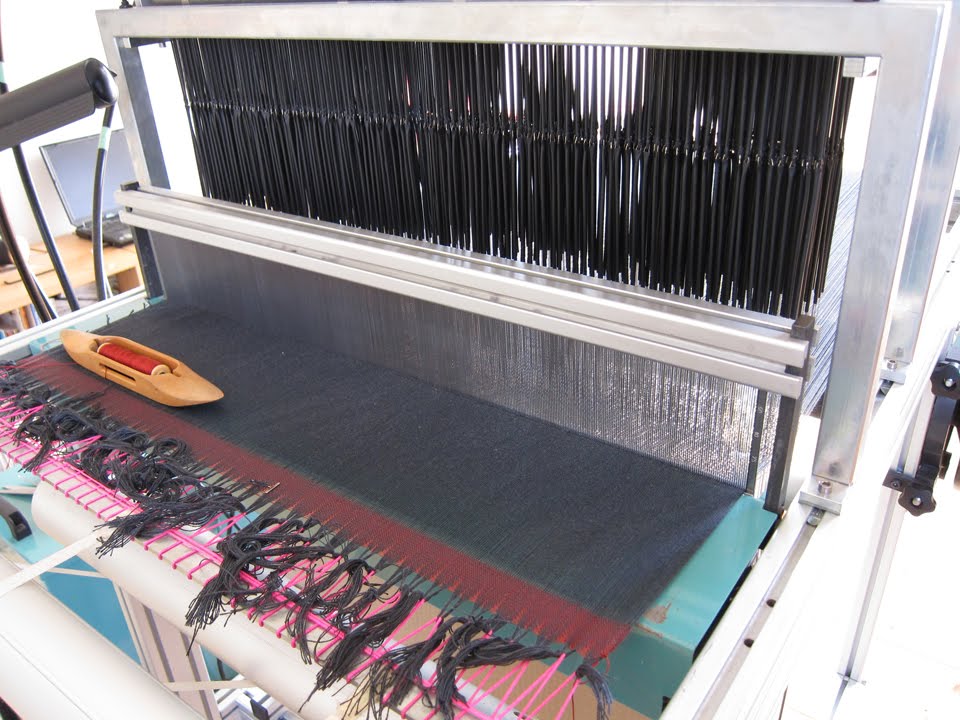
TC-1 with 4 modules, 60 epi, 14.4" in reed

I have always been weaving on my TC-1 (Thread Controller 1 Loom from Digital Weaving Norway) loom with four modules set up one behind the other, giving me a warp density (sett) of 60 ends per inch (epi) and a weaving width at the reed of 14.4 inches. Since the interlacement of warp and weft (weave structures) brings the warp in, most of my final work has averaged 13.5 inches in width. You can see the loom above from different sides. Note that the cardboard box is my own invention--cat-proofing the springs and heddles. I had it in my head that I would do a large weaving for my upcoming show (two-person exhibition at the Chandler Gallery) if I had the time, and, if so, I would reconfigure the loom to weave full-width. This would mean I would have a width of 28.8 inches at the reed, but my sett would decrease to 30 ends per inch.

When I finished my sky weavings--East and West--which I love, by the way, I started debating with myself--leave the loom alone or take a chance on reconfiguration? Everything was working so well, did I want to rock the boat? Would I have time to complete a piece? Did I have enough warp (it would have to be heavier than the 60/2 silk I was using to account for the smaller sett) for the new piece? If it was possible to worry about it, I did. But I always came back to the conviction that this was the time to change the loom and weave at a larger width. Call it fate.

My in-house saint, Mark Goodwin, reconfiguring the TC-1

Of course, my reconfiguring the TC-1 loom translates to Mark reconfiguring the TC-1 loom. You'd think it was enough that he has made all the beautiful frames for mounting my new work, but there is always something else I can think of to ask him to do. (Do you know that expression, honey-do?) We were greatly aided by a video clip of the process that Vibeke Vestby, the inventor of the TC-1, sent to us. We (I did help) had to remove the modules, put two of them together, replace them on the loom, modify the bottom slides that hold the springs, and basically we were done. It was amazingly easy and I could move on to my next fear--rethreading the loom.

Because the modules were moved, I had to completely rethread the loom. First we had to take a trip to Massachusetts to buy new yarn (I am using 20/2 silk from Webs) (now I can worry about my credit card bill), then I wound an 18 yard warp (my longest ever) and I put it on the back beam. In the past I used a quarter-inch raddle--but that left my hands when I sold my AVL dobby loom--so I used a one-inch raddle and knew the whole time I was doing it that it wasn't right. My back beam has flanges which need to be placed at exactly the width of the warp, but I had mine wider. Don't ask me why I didn't stop and get it right--I just didn't. Then I threaded the loom. There are 880 hooks on my loom, therefore 880 threads, and after a while I got a rhythm going--count out 10 heddles from the bottom spring bar, count out 10 threads, thread the heddles. Tie them off to the right. Untie ten threads from the group tied off to the left. Start again. If you read this blog regularly you already know that counting and numbers are a big part of my life, and repeating actions are basically the life of a weaver.

The threading went smoothly too--another worry hits the dust. Threading the reed was really simple--I just made a weave file that lifted two ends at a time and ran through that file putting the lifted ends into the dents of the reed. Then I pulled the whole 18 yards forward through the reed, called for Mark's help, measured and repositioned the flanges correctly, then slowly and very carefully wound back the warp under even tension. It looks great now.

TC-1 reconfigured to 30 epi, width at reed 28.8"

Note that the cat-protector had to be modified since the box was not wide enough to fit around the reconfigured springs. I think the corrugated cardboard looks much nicer.

Recently I got a copy of Weaving for Beginners by Peggy Osterkamp. I have been reading it at night, always receptive to find a new way to do something, and Peggy has plenty of smart ideas in this book. I usually lash on my warps to tension them at the front of the loom, and she suggests using a smooth slippery yarn, like a chalk and mason line nylon. A cry to Mark and immediately I had this hot pink nylon in my hands. It has replaced the cotton cord that I used to use. I am not sure it made a difference, but like the corrugated cardboard, it looks nicer.

Note the new pink cord tensioning the warp

The weaving I wove while I was debating the reconfiguration of the loom is called His Wife. I think of it as a self-portrait. It is probably the last 13.5" width weaving I will make for a long time. Now on to that big weaving.

His Wife by Bhakti Ziek, 2010

Friday, November 26, 2010

Sky Weavings

Detail of "West" by Bhakti Ziek

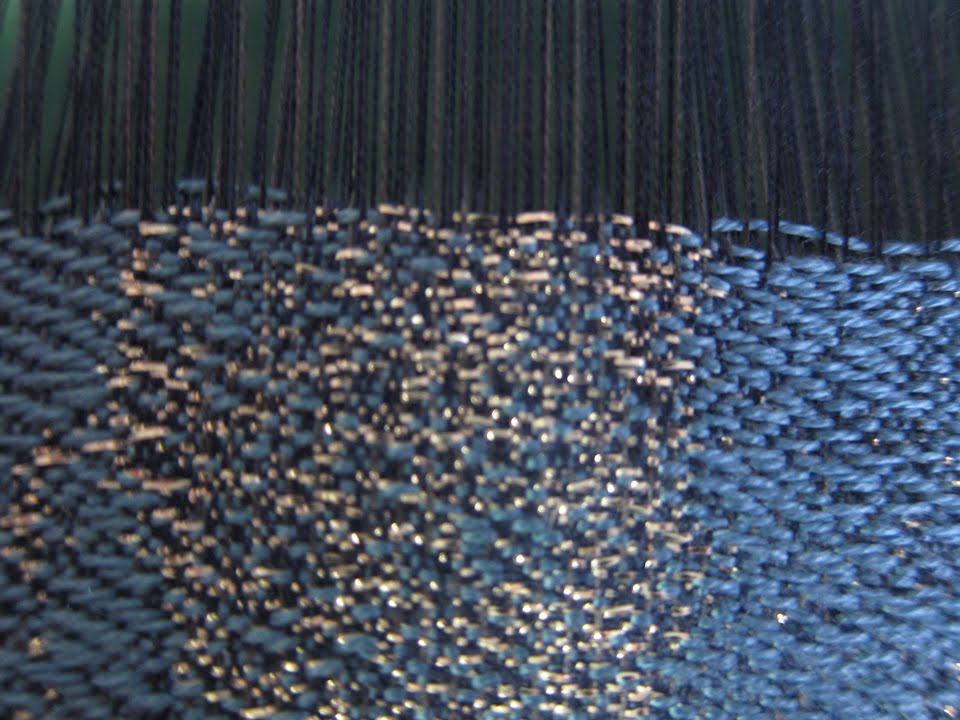
I am weaving a pair of sky weavings: "East" and "West". Two wefts alternate, a blue tencel and a silver gimp, in structures that bring one to the front and the other to the back ((weft-backed structures). When you combine structures in one weaving, you have to be sure that one is not significantly tighter than the other, or you will have take-up problems. In theory my five structures were compatible, but in fact they weren't. I created an image file that was pixelated, and the switching between structures happened so often in some areas that the wefts could not pack down evenly. You can see what happens in the two images below: the fell line of the cloth becomes uneven and the reed cannot hit the cloth evenly.

Fell of the cloth is uneven

Reed hits one edge before the other

Thinking of what I could do to solve the problem before it became so exaggerated that I would not be able to complete the weaving, I came up with the idea of hand-picking the weft in the tight areas. I often say that I love the TC-1 loom because it allows me to use all the knowledge I have acquired over the years as a weaver. This was one of those times that I used a process that I thought I would never have to do again on a jacquard loom. The pictures below show what I did. The first image shows the blue weft going across the cloth in the normal shed. As you can see, the cloth curves up where the weave structures are tighter than the other structures.

Weft following normal shed

Not on every pick, but often, I would take the shuttle and bring the weft to the back of the cloth in the tight areas.

Blue weft going to the back in center area

This enabled the next pick of silver to pack down tighter, making the fell of the cloth more even. It seemed to work fine, and 6420 picks later, the first weaving, "West" is woven. No turkey for us on Thanksgiving, but plenty of gratitude at the loom.

Silver weft packs into space more evenly now.

Sunday, November 14, 2010

Draw Like a Weaver

5 Wefts Used to Create This Weaving

Do you want to know how to draw like a weaver? I'll use a recent weaving built with five wefts as an example. Take 6 crayons or pencils or inks and arrange them so you will use them in the same sequence, over and over and over. In this case, weft one (color 1) is salmon, weft/color 2 is black, weft/color 3 is dark green, weft/color 4 is white, and weft/color 5 is light green. The sixth color represents the warp--red in this case. It might help if you have a page with horizontal lines on it, or under it as a guide, or just go freehand--weavings tend to be wobbly even though they follow a grid.

How a Weaving Builds

Now make a series of horizontal dashes, on the same line, with the red color that represents where you want that color in your image. Follow this with some dashes on the same line with the black color where black should go. Put the black down and pick up the light green and draw your light green dashes on the same line. Then put that color down and pick up the white color--and draw your horizontal dashes on the same line, followed by some horizontal dashes of the dark green. Depending on your image, you might have filled in the complete horizontal row, if not, fill in the spaces with the red color, which represents the warp. Now move to the next line and continue building color by color, line by line. Some lines might not show any of one color. You get a break here drawing on paper, but as a weaver, that weft is still thrown, working at the back of the cloth rather than the front.

Most of my recent weavings are composed of series of four or five weft colors. I am averaging 140 picks per inch--sometimes more, sometimes less. If using four wefts, that means they pack down to look like 35 horizontal rows composed of four colors, plus warp color. To be fair, I don't actually draw my images line by line but use Photoshop to make compositions and insert weave structure. The book Alice Schlein and I wrote, The Woven Pixel: Designing for Jacquard and Dobby Looms Using Photoshop®, is a great resource if you want to learn how to do this. When I want to weave a design though, I do have to build it, pick by pick, and in this example that would mean five picks (wefts) create one horizontal row in the cloth. It is not unusual for my weavings to exceed 5000 picks. I am standing at the loom most of the time, though recently I obtained a stool that I can use too. 300-400 picks per hour adds up to alot of hours at the loom. What would be excruciating for some people turns out to be sanity for me.


Sea Glass formation on Bear Island

Sea Glass by Bhakti Ziek, handwoven jacquard 2010

Night Cap

Sometimes though I want things to move a bit faster. Sea Glass was woven in a new structure for me, a lampas that used a plain weave ground against a three shaft patterning twill. I dropped my wefts to three systems in the center, but created 15 structures with them. The sides of the weaving are a damask structure using just one weft. When I saw this bottle of wine at the store I had to buy it. I didn't know sea glass existed until the summer vacation in Maine, but the wine and wikipedia showed me it is a well-known phenomena.

Wednesday, November 3, 2010

Two New Weavings

Continuum by Bhakti Ziek

The weaving shown in the last post is finished. I am calling it Continuum, which is also the name of my upcoming show that opens at Chandler Gallery on January 8th. The image above does not do justice to the actual piece. Maybe you can come to the exhibit and see what I mean.

56 Blossoms by Bhakti Ziek

56 Blossoms will also be in the exhibition. I was thinking about this weaving today as I worked at the loom, and this came to me: When you are in dispair, you have to come up for air. Also: Often the solution is found in the problem. Do you think I can sell these platitudes to a fortune cookie company?

Wednesday, October 13, 2010

Raspberry Coulis

Current Warp

I am working on this red warp that is making me hungry! It is tapping into my obsession with Top Chef, which is doing a dessert series right now, so I have named this warp Raspberry Coulis.

Work in Progress by Bhakti Ziek

It is amazing how many colors I can get out this warp and four wefts (blue, yellow, tan, and white). This is the first time I have had tension problems on the TC1, compounded by the fact that not all the wefts are the same size, and some of the structures bring two wefts to the surface and some bring one to the surface. I think the distortion is interesting, something I might want to explore this winter to see if I can control it and do it on purpose, but I am not sure how I feel about it in this piece. Well, have to finish it before I can judge.

Tuesday, October 5, 2010

Bear Island and Code

Bear Island by Bhakti Ziek

I wove Bear Island (above) after a week on that incredible island. It is 29.5"w x 13.5" high. Think sea rocks, letters from a gravestone and an "energy" overlay.

Code by Bhakti Ziek

This is Code finished. Images of it in process were in earlier posts. It is 40.5"w x 13.25"h. If you remember the images on the loom, it has changed color. I dyed it with inexpensive black tea. I noticed the grass outside died where I poured the tea out, so image what it is doing to my insides.
Bear Island and Code with Sculpture by Mark Goodwin

An interior shot of the office room, which is looking good with work by me and Mark, and a felt rug from Turkey on the floor. Fortunately the rug is old and frayed, because our cats are making it more frayed by the minute.

Chris Allen-Wickler sewing weaving by Bhakti Ziek

Lucky me, not only do I get a visit with Chris (above) but she is helping me finish some of the weavings. When I was weaving my thesis work at Cranbrook, she and Marcie Miller-Gross saved my life by hemming the work as it came off the loom--and we were working up to the last minute. Fun to revisit those days so many years later--on one hand it seems like no time has passed, on the other when we talk about her daughter at University of Michigan, we realize it has been many years. Chris is here between shows--she will exhibiting her fabulous garments (Allen-Wickler Artwear) at the Letchworth Craft Show near Mt. Morris, NY this weekend.